On this page
A parent's guide to chess time controls — classical, rapid, and blitz — with age-appropriate picks, increment explained, and when each suits children.

Day-to-day coach at ChessWize. 7+ years training students aged 5–15 across India, the USA, the UK, Singapore, Australia, and the Middle East. Known for structured, interactive sessions that turn nervous beginners into tournament-ready players.
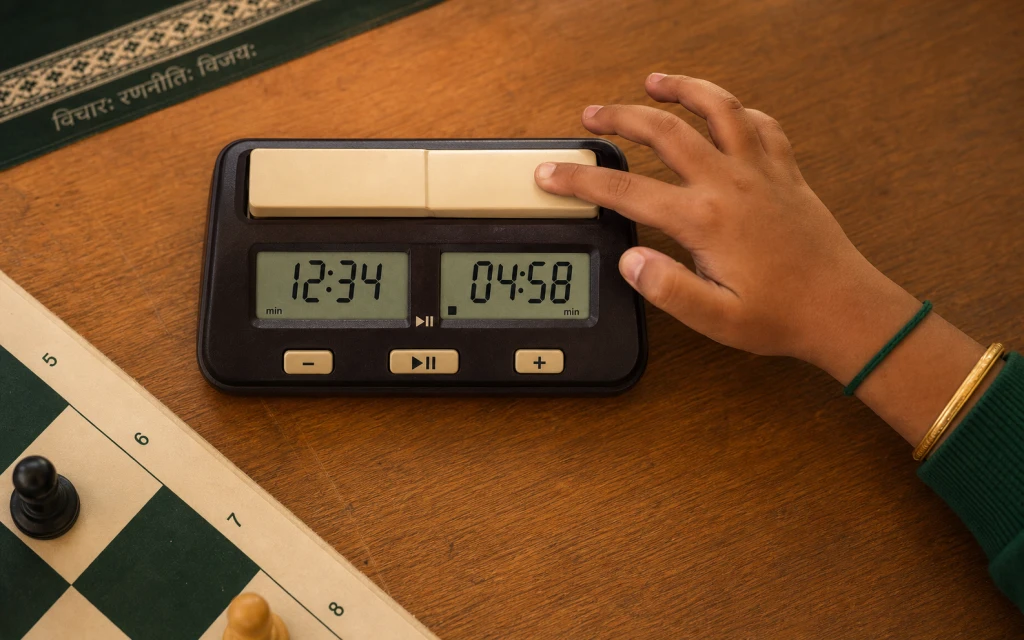
Chess Time Controls for Kids: What Every Parent Needs to Know#
By Coach Hrdyansh Pandey · Last updated 16 July 2026 · Fact-checked by Coach Tarun Gupta
For a child’s first competitive chess, choose rapid — about 15–25 minutes per player with a 10-second increment. It balances real thinking time against a young attention span, and it is the format most Indian junior tournaments use. Save classical (60–90 minutes) for after six months of coaching, and treat blitz (under 10 minutes) as occasional fun, not training.
“My child ran out of time with a completely winning position.” I hear that sentence from a parent at least once a week. Managing the clock is a chess skill in its own right — separate from knowing good moves, and just as decisive on the scoresheet. Understanding time controls helps you pick the right tournaments and helps your child build sensible clock habits before those habits are tested under pressure. ChessWize, the online academy publishing this guide, runs live online classes for kids aged 5–15 where clock discipline is coached from the very first competitive game.
What are the three main chess time controls?#
FIDE, the world chess body, sorts time controls into three official categories by how much time each player gets for the whole game: classical (long), rapid (medium), and blitz (short). Each has its own rating list and its own place in a child’s development. Bullet — under three minutes — sits below blitz and is best thought of as a video game, not training.
Classical chess#
Definition: each player has at least 60 minutes for the game, or the equivalent once increments are counted. Common classical controls in Indian junior events are 60 minutes + 30-second increment and 90 minutes + 30-second increment per move.
What it means for kids: classical games are long. A single game can run 2 to 4 hours, which demands sustained concentration, patience, and genuine physical stamina. Children who are not used to it play well for the first 30 minutes, then rush the rest because they are mentally tired — and throw away good positions in the final ten moves.
Why it matters: classical is treated as the “real” form of chess by most coaches and professionals. AICF state and national championships use classical controls, and classical FIDE ratings carry the most weight in the chess world. If your child is aiming at the serious competitive track laid out in our tournament and rating pathway guide, classical is the destination.
Who should play it: children aged roughly 8+ who can concentrate for an hour or more without a break. I recommend starting classical tournament play only after at least six months of coaching and three or four rapid tournaments for experience.
Rapid chess#
Definition: more than 10 minutes but under 60 minutes per player. Common junior controls are 15 minutes + 10-second increment and 25 minutes + 10-second increment.
What it means for kids: rapid games last 30 to 90 minutes. This is the sweet spot for most children — long enough to think carefully about the moves that matter, short enough to hold concentration from start to finish. Most weekend junior tournaments in India use rapid, so it is also the format your family will encounter most.
Why it is ideal for beginners: rapid teaches a child to balance thinking time against decision speed. It feels fast enough to be exciting yet slow enough for genuine calculation. I recommend it as the default for a child’s first tournament and for regular competitive play through the early years.
Rapid rating: FIDE keeps a separate rapid rating list, so a child can hold a different classical and rapid number at the same time.
Blitz chess#
Definition: 10 minutes or less for the whole game. Common controls are 3 minutes + 2-second increment and 5 minutes + 0 (no increment).
What it means for kids: blitz is fast and thrilling — and, used wrongly, it can quietly work against a young player. At blitz speed children move on instinct rather than calculating. They build quick pattern recognition, but they also risk building sloppy habits — not checking a line, playing “hope chess,” moving before looking — that carry straight into slower games.
My recommendation: children under 10 should rarely play blitz. Children aged 10–14 can enjoy it occasionally, but never as their main training method. The instincts blitz rewards are the opposite of the deep, careful calculation classical improvement requires. When a student’s classical results stall, the culprit is often too much blitz.
When blitz earns its place: as fun after serious practice is done, and for sharpening pattern recognition once a solid tactical foundation already exists. Casual online blitz on Lichess or Chess.com is fine in small doses — the limits I use are in the practical section below.
How do increments work, and why do they matter for children?#
An increment is extra time added to your clock after each move you complete. “30-second increment” means your clock gains 30 seconds every time you finish a move. It is the single most kid-friendly feature of a time control, and I steer families toward events that use one every time.
Without an increment, a child can lose on time even holding a completely winning position — the game is scored as a loss regardless of what stands on the board. With an increment, the child always has at least the increment time for each move, which removes the pure time-forfeit loss. A control of 15+10 (15 minutes plus a 10-second increment) is far gentler on a young player than 15+0 (15 minutes, no increment). Think of the increment as a safety net stretched under the most demoralising way to lose a chess game.
There is a second, subtler benefit. Because the increment refills a little time on every move, it teaches children they are never truly out of time as long as they keep moving. That calms the panic that makes kids blunder in the final minute, and it makes the FIDE rating regulations behind rapid and classical events feel less frightening once a child understands the mechanism.
Coaching time management: a worked example from my own students#
In ten years around junior chess — seven of them coaching full-time — I have found that clock trouble is almost never a knowledge problem. The child knows good moves. They simply spend their time in the wrong places. So instead of lecturing about the clock, I run a specific drill, and I want to walk you through it exactly as I do with a student, because you can repeat it at home.
I set up a rapid game at 15+10 and I give the child one rule: after every move, glance at the clock and say the time out loud. Nothing else changes. The first few games feel clumsy — kids forget, I remind them, we restart the habit. Within three or four games the glance becomes automatic, and something interesting happens. The child starts noticing their own pattern. One student, a nine-year-old preparing for his first AICF event, discovered he was burning six or seven minutes in the opening — moves he already knew cold — and then had four minutes left for a 25-move middlegame. He was not a slow thinker. He was thinking hard about the wrong moves.
The fix was a mental map I teach every student. The opening is a highway: if you have prepared the position, drive fast, because there is nothing to calculate that you have not already seen. The middlegame is a crowded city: slow down, look both ways, calculate — this is where games are won and lost. The endgame is parking in a tight spot: precise, unhurried, one careful move at a time. That nine-year-old cut his opening time to under two minutes within a fortnight, which handed the rest back to the middlegame where it belonged. His results in that first tournament were middling, as first tournaments usually are, but he never once lost on time — and not losing on time in a won position is worth more early rating points than any opening trick.
The deeper lesson I want parents to take from this: time trouble is a decision problem, not a speed problem. A child who spends eight minutes agonising over which good move to play in a quiet position, then thirty seconds on a sharp tactical moment, will lose games no matter how strong their chess is. The drill above surfaces that pattern so the child can feel it themselves. I have never once succeeded by simply telling a child to “play faster” — that just produces faster blunders. Showing them where their time goes, in their own words, is what changes behaviour. If you want a structured version of this and other habits, our FIDE rating and Elo guide and our rating-improvement guide both build on the same principle: process before numbers.
Expert tips: clock habits I teach every student#
- Play the prepared opening fast. If your child has learned their opening moves, those moves should take seconds, not minutes. Save deep thought for the middlegame, where the real decisions live. “Drive fast on the highway, slow down in the city” is the exact phrase I use, and children remember it.
- Spend time only on critical moments. Teach your child to recognise when to think deeply — the opponent just made a surprising move, there is a tactic in the air, a structural decision is due — versus when to move quickly, such as forced recaptures and obvious replies. Most lost time is spent on positions that did not deserve it.
- Check the clock every five moves. A tiny habit that prevents most time trouble. Kids get absorbed and forget the clock exists until it is nearly empty. Rehearse the glance in casual games at home until it is automatic, using the say-it-out-loud drill above.
- Never spend more than 10% of your remaining time on one move. With 20 minutes left, no single move should eat more than about 2 minutes. This one rule stops the classic disaster of pouring ten minutes into one decision and leaving nothing for the rest of the game.
- In the last two minutes, move and trust the increment. When the flag is close, the increment is your friend: keep making sound, quick moves and let the clock refill. Panic-thinking in low time causes more blunders than any position ever does.
Matching the time control to your child’s stage#
A simple progression works for almost every child. Start at home and in class with longer rapid or even untimed games so calculation, not speed, is the focus. Move to 15+10 or 25+10 rapid for the first competitive season — this is what our coaches use in live online classes when preparing a child for their debut. Add classical only once the child comfortably concentrates for an hour and has a few rapid events behind them. Keep blitz as a treat throughout, capped tightly. Families in Chennai, Mumbai, and other cities all follow the same ladder — the format matters far more than the city.
If you are still deciding whether structured coaching is worth it before your child competes, our online chess coaching hub and our courses page explain how we sequence formats across a term, and you can meet the FIDE-rated coaches who run the sessions. Time controls are one small piece of a larger tournament and rating pathway — but getting them right early spares your child the two most avoidable heartbreaks in junior chess: losing on time, and burning out on blitz.
Frequently Asked Questions#
What time control is best for a child’s first tournament?#
Rapid — roughly 15 to 25 minutes per player with a 10-second increment. It gives enough time to think through real decisions but keeps a game to 30–60 minutes, which matches a child’s attention span. Almost every weekend junior event in India uses rapid, so it is also the format your child will see most often early on.
Should kids play blitz chess?#
Sparingly. Blitz is fun and sharpens pattern recognition, but at 3 or 5 minutes children move on instinct instead of calculating, and those habits leak into serious games. I let students aged 10–14 play a few blitz games for enjoyment after their real practice is done, never as the main training method, and I keep children under 10 away from it almost entirely.
What is an increment in chess?#
An increment is extra time added to your clock after every completed move. A “10-second increment” means you gain 10 seconds each move, so you always have at least that much time for the next decision. Increments prevent the most painful loss in junior chess — running out of time in a completely winning position — so always pick tournaments that use them.
How long does a classical chess game take for a child?#
A classical game with a 60- or 90-minute base plus a 30-second increment can run 2 to 4 hours. That is a lot of sustained concentration for a young player, which is why I only move a child to classical after six months of coaching and a few rapid events. Stamina and clock discipline matter as much as chess knowledge at that length.
Are online ratings the same as FIDE rapid or blitz ratings?#
No. Online ratings on Lichess or Chess.com use their own pools and formulas and are not comparable to over-the-board FIDE or AICF ratings. A child might be 1300 blitz on Chess.com and 900 FIDE rapid — both are normal. Use online ratings to track practice trends, not as a substitute for official ratings. See our FIDE rating and Elo guide for the details.
Does my child need a different rating for each time control?#
Yes. FIDE maintains separate standard (classical), rapid, and blitz rating lists, and AICF mirrors this structure. Your child can hold three different official numbers at once. For most junior players in India the classical rating is the headline metric, but strong rapid and blitz ratings are perfectly legitimate and useful for measuring specific skills.
Back to parent hub: Chess tournament and rating pathway in India.
See also: First tournament guide · AICF tournaments for beginners · Chess practice for kids at home
Return to the main hub: Online chess coaching for kids in India.
Hrdyansh Pandey
Day-to-day coach at ChessWize. 7+ years training students aged 5–15 across India, the USA, the UK, Singapore, Australia, and the Middle East. Known for structured, interactive sessions that turn nervous beginners into tournament-ready players.
View FIDE ProfileReferences & Sources
- [01] FIDE classifies classical, rapid, and blitz by time thresholds in the Laws of Chess and rating regulations — https://handbook.fide.com/chapter/B022017, 2024
- [02] Rapid chess is defined as more than 10 minutes but under 60 minutes per player; blitz is 10 minutes or less — https://en.wikipedia.org/wiki/Fast_chess, 2026
- [03] FIDE publishes separate standard, rapid, and blitz rating lists that update monthly — https://ratings.fide.com/, 2026
- [04] Chess.com explains standard time-control categories and increment for club and online play — https://www.chess.com/terms/chess-time-controls, 2026
- [05] The Elo rating system was adopted by FIDE in 1970 to measure relative playing strength — https://en.wikipedia.org/wiki/Elo_rating_system, 2026