On this page
AI dashboards and live coaching compared: where Aimchess helps, where it cannot, and how to choose for your child in 2026.

Founder of ChessWize. 10+ years in chess education with international academy experience. Designs the structured curriculum that every ChessWize coach teaches. Best for parents who want a clear progression path, not just lessons.
For parents
Key takeaways
- 1Aimchess is useful for trend spotting and homework planning, but it does not replace coached correction, emotional support and tournament planning for children.
- 2For children under 14, live coaching and coach accountability are usually more important than AI speed.
- 3A strong setup is coach-led coaching with Aimchess as a daily homework monitor.
- 4Online chess tools work best when a named coach interprets the dashboard and assigns practical next actions.
- 5ChessWize uses same-coach sessions, weekly parent reporting, and a complimentary demo for families who want a safe way to test fit.
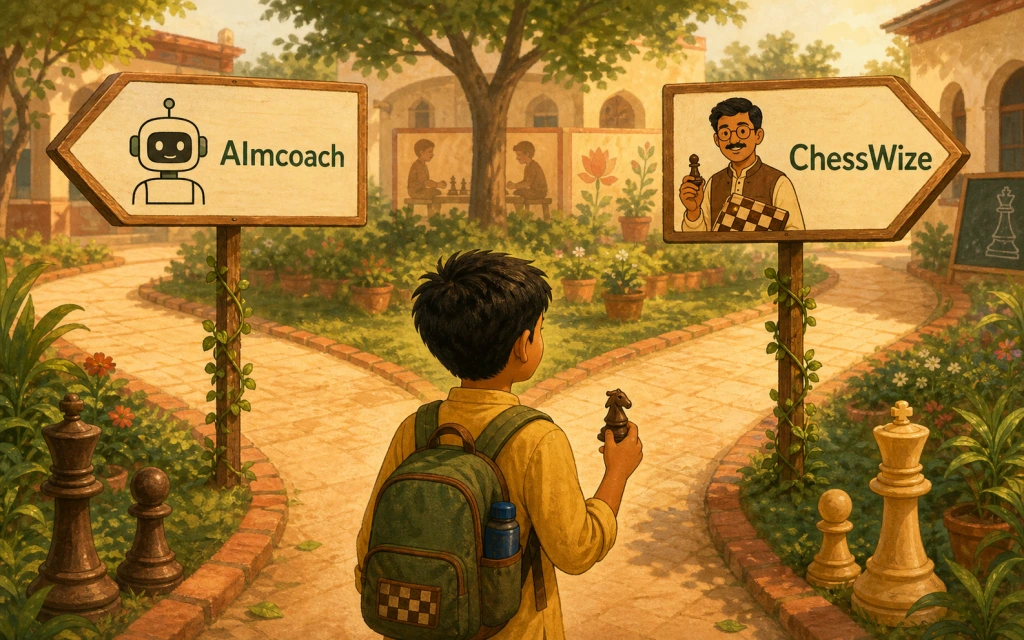
ChessWize vs Aimchess for Kids: AI That Reads Moves, and a Coach Who Reads Your Child#
For most children, Aimchess is a useful analysis mirror, while ChessWize coaching is the person who teaches your child how to change. Answer first: choose live coaching as your foundation, then use Aimchess for assigned repetition and pattern checks between sessions, especially if your child can follow a dashboard independently.
Disclosure: ChessWize, the site you are reading, is a live-coaching academy and one option in this comparison. Competitor details were checked on their public pages and on the same date set used across internal comparison records.
I’m Tarun, and this article is not an either/or sales split. It is about function. In my sessions, I have seen children improve when AI gets a human spine and a practical routine. If your goal is a simple answer: AI tells you patterns; a coach changes habits. That is the difference you should budget for.
Here is the simple route before we go deep: compare all major options in the comparison hub, then jump into online chess coaching for kids in India if you are ready to choose a format.
Which of these is better for my child this month?#
For a child aged 5–15, the right answer is almost always a coach-led workflow first, then an AI layer if your child needs extra volume. A child who loses concentration in one lesson still needs live instruction to rebuild game habits. A child who already plays with discipline can use AI data to speed daily repetition.
Your immediate decision is about reliability. If your child needs constant prompting, live coaching should be the base. If your child can independently act on feedback, AI tools can be a useful support. It is the same reason group vs private classes is a coaching decision first, not a gadget decision.
What Aimchess is good at, in plain terms#
Aimchess does three things that are genuinely practical:
- It tracks score patterns across many games without emotional fatigue.
- It highlights recurring tactical and time-management issues and gives focused practice recommendations.
- It gives a measurable checkpoint for homework.
This aligns well with online schedules. A coach in a structure that includes chess home practice on Lichess or Chess.com can use the report to assign focused tasks. But this is why Aimchess cannot be the only method for children: it cannot see decision quality at the moment of choice.
To be specific about what you actually get: Aimchess imports a child’s games automatically from Chess.com or Lichess and scores them across six skill categories — tactics, endgame, advantage capitalization, resourcefulness, time management and opening performance. It ships a free Standard tier (roughly 40 games analysed per month, a weekly study plan and one daily training session) and a Premium tier at $7.99/month or $57.99/year, per Aimchess’s own pricing as verified in our comparison set on 16 July 2026. There are 12-plus training modules, including named ones like Blunder Preventer, Opening Improver and Blindfold Tactics. Aimchess also publishes a marketing claim that its personalised puzzles raise rating “31% faster” than standard tactics training — that is a company-published figure, and we could not independently verify it, so treat it as a vendor claim rather than a proven result. Note too that Aimchess states no specific age range; it is a general-audience tool, not a children’s product, which matters when you hand a dashboard to a nine-year-old.
What live coaching does that AI cannot#
In one lesson, I see three things AI cannot:
- What the child understands: AI can score move quality, but it cannot reliably infer whether a child grasps the why behind a decision.
- How a child recovers from pressure: a single bad game can trigger silence, avoidance, or self-doubt in a child. The coach notices and adjusts immediately.
- Context: school exams, tiredness, and confidence swings all change learning speed. A coach reads that context and shifts pacing.
That is why we stress the weekly rhythm at ChessWize: same coach every class, structured goals, and weekly parent reports. The same child is not coached by an algorithm. They are coached by continuity.
A practical comparison using our own facts and public competitor records#
| Layer | Aimchess | Live coaching |
|---|---|---|
| Ownership of decisions | Child + dashboard | Coach + child + family |
| Correction depth | Generic pattern correction | Personal diagnosis and habit design |
| Parent reporting | Dashboard only | Session updates and homework review |
| Emotional support | Not available | Core coaching part |
| Tournament prep | No direct prep | Full prep: openings, schedules, nerves |
| Fit for under 14 | Optional support | Usually primary |
| Pricing style | Tool subscription | Session-based coaching investment |
| Accountability | Child follows or stops | Coach tracks consistency |
Competitor coverage changes by product type. Public records in our internal comparison set show Aimchess as an AI-analysis product, while Chess.com and ChessKid are also self-guided ecosystems. This is useful context: if a parent asks for a “coaching replacement,” the honest answer is no — at least not at primary level.
Where Aimchess genuinely wins over a coach#
Fairness matters, so here is where the tool is honestly better than a human. Aimchess aggregates patterns across a large sample of games — 50 or more — far faster than any coach reviewing games one session at a time. If your teenager plays 200 games a month, a coach cannot manually sift all of them, but the tool can surface that, say, time-management scores drop sharply after move 20 across dozens of games. That quantified, category-by-category tracking is objective in a way a coach’s session memory is not, and it costs a fraction of coaching time.
For a self-motivated older or teen player who already keeps a practice habit, that is real value. The tool never tires, never forgets last week’s pattern, and gives a measurable checkpoint between lessons. What it does not do — per the same public product record — is diagnose why a mistake happened (a calculation slip, a concept gap, time pressure or nerves all read as the same “inaccuracy”), hold a child accountable when they ignore the plan, prepare for a specific tournament opponent, or carry any Indian or AICF context. Those four gaps are exactly the work a live coach owns, which is why the honest recommendation is a layered setup, not a replacement.
When Aimchess is enough#
For older, motivated teenagers, mostly independent learners, Aimchess can be useful. It also works for families trying to create a daily routine while waiting between coach lessons. In that setup, the coach assigns one short target, the child follows a practical task list, and both review results.
Avoid a common mistake here: treating dashboard improvements as equivalent to tactical thinking maturity. If your child can play the assigned puzzle routine and keeps habits through a rough week, the setup works. If not, that is not a dashboard failure — it is a coaching-readiness sign.
Deep dive: the one error pattern that reveals why a coach is still needed#
Let me be concrete with a real working pattern. A child makes the same “hung piece” blunder repeatedly. Aimchess correctly marks tactical inaccuracy, sometimes with a low tactical score. A coach and parent may read that as “needs tactics.” In this age group, the child might not even be in the tactical stage yet.
In a coached lesson, I pause and ask, “What did you look at before your move?” Most of these blunders are not about tactics knowledge at all. The child often ignored king safety for speed, did not process threats, or played from the impulse to recover faster. During one 45-minute block, I can observe what thought was skipped.
I then set one habit, one line of thought, and one check. For example: before every middle-game move, the child must ask one of three safety questions out loud. That is what turns a repetitive mistake into a trainable routine. Over the next week, Aimchess can then verify if the pattern changed. This is the key: AI becomes measurement, while coaching creates the intervention.
With this one case, you can see why I say Aimchess is a strong mirror. It shows where to look. It still cannot run the lesson for you.
How to test this at home before paying for long plans#
Use a short, controlled comparison:
- Book one complimentary demo and one private or group class. Ask your child to attempt one tactical theme for one week.
- Use one simple AI session at the end of the week.
- Compare three markers: Did the child improve their thought process? Did they follow the routine without reminders? Did their game confidence improve after losses?
If two of three improve only after reminders, the child likely needs live coaching. If all three improve independently, AI is a useful support. If both improve, great — that is an ideal hybrid and exactly what many families do with online coaching in India.
Which format and product mix should I choose by goal?#
For children starting tournament play, choose coaching because event prep has opponent-specific planning and pacing needs. For families building basic habits at home, mix with ChessKid, Lichess and Chess.com tools.
If your city is part of our online chess classes for kids in Mumbai, Bangalore, or Delhi list, pricing and scheduling are easier to map with local exam timings and language preferences. You can also review all available plans on courses and the profile-led coaching team on coaches.
Expert tips#
- Start with one weekly target only. If your child has no routine yet, too many targets become another place they can fail quickly.
- Use AI reports in one place. Ask your child to do one assigned activity after receiving it, then review only that activity in the next class.
- For younger children, use coach direction for habits and AI only for repetition. Habit failure is common at under-14 and needs correction in class, not only through app prompts.
- Keep one fixed parent metric: attendance, task follow-through, and game calmness after losses. Ratings are not the only signal.
- Compare providers on continuity and reporting. A cheap option with no weekly feedback often costs more later in time and confidence loss.
FAQ#
Can AI replace a chess coach for kids?#
Not for most children. AI can track repeating game patterns, but it cannot replace live correction of thinking habits or emotional support after setbacks. For older motivated students, AI is best used under coach direction.
Which is better for children: Aimchess or live coaching?#
If your child is not yet consistent in attention and follow-through, coaching should be primary. AI works best as a supplement for homework, repetition and dashboard trend checks.
Does Aimchess work for children under 14?#
Yes, but as a support tool rather than a base method. Under-14 learners usually need adult guidance for coaching depth, accountability and emotional support.
How should I decide between a paid subscription and coaching?#
Treat AI as a task layer and coaching as the teaching layer. A live schedule gives structure, corrections and reporting; AI fills in daily repetition when your child can work with it.
Is there a recommended coach + AI combination?#
Yes: coach-led plan each week, one AI-supported assignment each day, weekly reporting to parent. This avoids dashboard overload and keeps learning practical.
What if my child is nervous before tournaments?#
Live coaching is usually the better base because it handles nerves and format-specific readiness directly, including timing and stress habits.
Sources#
- Aimchess feature overview and product scope — https://www.aimchess.com/
- FIDE overview and rating governance — https://en.wikipedia.org/wiki/FIDE
- Elo rating explanation — https://en.wikipedia.org/wiki/Elo_rating_system
- Lichess platform details and free-tier scope — https://lichess.org/about
- Chess.com platform and analysis ecosystem — https://www.chess.com/
- AICF federation info and registration context — https://aicf.in/
Back to the parent hub: online chess coaching for kids in India.
See also: ChessWize vs Chess.com for kids and ChessKid vs live coaching.
Tarun Gupta
Founder of ChessWize. 10+ years in chess education with international academy experience. Designs the structured curriculum that every ChessWize coach teaches. Best for parents who want a clear progression path, not just lessons.
View FIDE ProfileReferences & Sources
- [01] Aimchess imports games from Chess.com and Lichess and maps key skill signals with AI insights — https://www.aimchess.com/ , 16 Jul 2026
- [02] FIDE is the world chess federation and maintains the rating list used globally in modern competitive chess — https://en.wikipedia.org/wiki/FIDE , 16 Jul 2026
- [03] The Elo system measures relative player strength and is the historical baseline for rating comparison — https://en.wikipedia.org/wiki/Elo_rating_system , 16 Jul 2026
- [04] Lichess is free with no paid tier and offers engine analysis, puzzles and classroom-like practice tools — https://lichess.org/about , 16 Jul 2026
- [05] Chess.com is a large online platform with engine review, puzzles, opening explorer and game tools used by families — https://www.chess.com/ , 16 Jul 2026
- [06] India federation registration information is listed on the AICF official page for player registration and participation pathways — https://aicf.in/ , 16 Jul 2026