On this page
A practical comparison of online and offline chess classes for kids in India — pros, cons, real costs, logistics, and the hybrid approach that works best.

Founder of ChessWize. 10+ years in chess education with international academy experience. Designs the structured curriculum that every ChessWize coach teaches. Best for parents who want a clear progression path, not just lessons.
For parents
Key takeaways
- 1Online coaching removes the geography barrier — a child in a Tier-2 city can learn from a titled coach anywhere in India.
- 2Offline classes prepare a child for over-the-board play — physical clocks, scoresheets, and touch-move discipline.
- 3For competitive goals, a hybrid plan works best: online for structure, offline or home for over-the-board practice.
- 4Offline classes carry venue overhead (rent, utilities) that online coaching does not.
- 5Board-exam season (Feb–March) rewards online scheduling flexibility over rigid fixed-slot academies.
Online vs Offline Chess Classes for Kids: Which Format Works Better?#
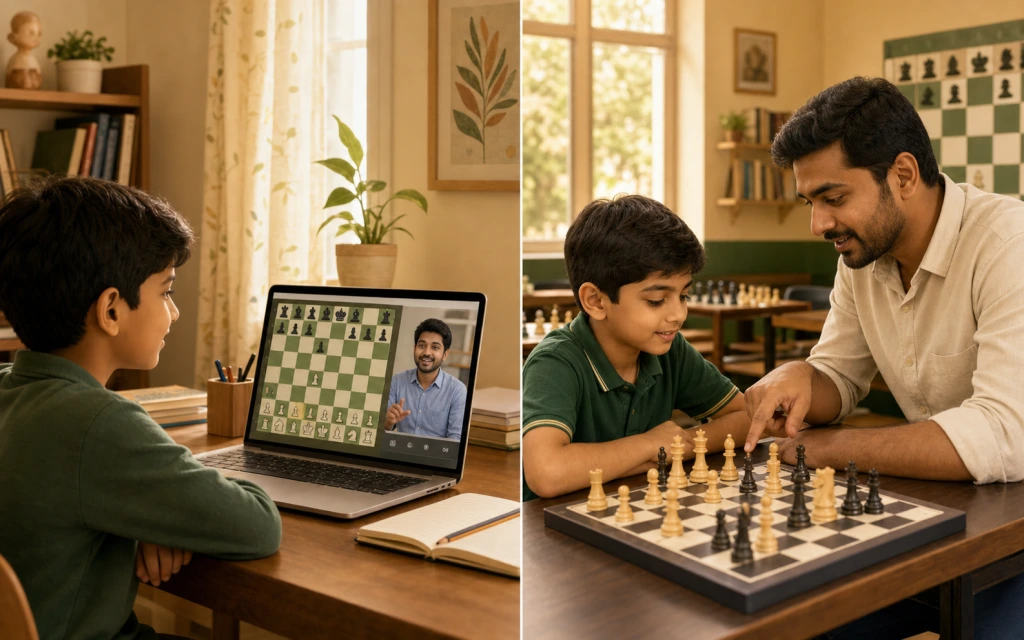
Online and offline chess classes both work, and the right choice depends on your child’s age, your city, your schedule, and whether tournaments are part of the plan. Online removes the geography barrier and adds scheduling flexibility; offline builds over-the-board readiness. For most families with competitive goals, a hybrid of the two beats either one alone.
This is the second question Indian parents ask me most, right after “which academy should I choose?” Having coached students in both formats over more than a decade, and having built an academy around the online model, I will be direct about what each does well and where each falls short. India has its own logistics, traffic, geography, and board-exam seasons, that make this comparison different from what you will read on international sites like Chess.com or Lichess.
Online chess classes: strengths and limitations#
What online classes do well#
Access to quality coaches regardless of location. This is the single biggest advantage for Indian families. If you live in a Tier-2 or Tier-3 city, the number of FIDE-rated coaches available locally is small. Online coaching removes that barrier entirely. A child in Indore can learn from a titled coach based in Chennai without either of them leaving home. Our guide to finding a FIDE-rated chess coach covers how to vet credentials properly.
Schedule flexibility. Online sessions fit around school, tuition, and other activities. During board-exam season in February and March, families can reduce frequency or move to weekends without losing their slot permanently. A fixed-schedule offline academy rarely allows that.
No commute. In metros like Mumbai, Delhi, Bengaluru, and Hyderabad, a 30-minute class can mean a 90-minute round trip through traffic. For a parent juggling several children’s schedules, that commute cost, in time, energy, and fares, is often the deciding factor. Online classes convert dead travel time into practice time, and that compounds over months.
Strong digital tools. Modern online coaching uses interactive boards where the coach draws arrows, highlights squares, sets up positions instantly, and shares live analysis. For explaining tactical patterns and multi-move variations, this is often clearer than a physical demonstration board, because the coach can show a line, undo it, and try an alternative in seconds. Sessions can be recorded for review, which a physical classroom cannot offer. Our explainer on how online chess classes work shows a typical session in detail.
Lower overhead, so lower fees. Without rent, utilities, and building maintenance, online academies avoid a whole cost layer that offline centres pass on to parents. To put real numbers on it: ChessWize starts at ₹2,500 for eight classes, which is about ₹313 a session, with group sessions at ₹375 and one-to-one at ₹1,000. For comparison, another online academy, ChessGaja, publishes group classes at ₹3,250 a month and one-to-one at ₹1,700 an hour in India (verified July 2026). Fees vary by academy, but the online model consistently avoids the venue cost that pushes offline pricing up.
Where online classes fall short#
The over-the-board gap. This is the most significant limitation, and it matters enormously for competitive kids. Online chess is played with a mouse click. Tournament chess, the kind sanctioned by AICF and played at district, state, and national level, uses physical pieces, a real clock, a paper scoresheet, and an opponent across the table. Children who train only online often struggle with clock management, touch-move discipline, and notation at their first over-the-board tournament.
Screen fatigue. A child who already attends school online, or spends significant screen time on homework, may resist another hour on a screen. For children under seven, long screen sessions are hard: attention wanders and eyes tire.
Fewer in-person social cues. Chess has a social side, reading an opponent, managing nerves across a real board, feeling the atmosphere of a tournament hall. Online group sessions help, but they do not fully replicate that energy.
Supervision needs for the youngest. Children under eight often need a parent nearby to handle technical hiccups and keep focus off other tabs. That is a real, if indirect, time cost.
Offline chess classes: strengths and limitations#
What offline classes do well#
Tournament-ready skills from day one. In an offline class, your child handles physical pieces, real clocks, and paper scoresheets. When they walk into a first AICF-rated event, the environment feels familiar rather than foreign. Touch-move, clock etiquette, and the discipline of sitting still for a full game all get practised naturally.
A structured social environment. Physical clubs create friendships, rivalries, and motivation that online groups match less easily. Children push each other, celebrate wins together, and process losses in a shared space.
Better focus for the youngest. Children under seven often concentrate better with a physical board and a coach in the room. The tactile act of moving pieces helps young learners internalise ideas, and a present coach can spot drifting attention faster than a webcam allows.
No screen time. For families managing digital exposure, offline chess is a genuinely screen-free intellectual activity.
Where offline classes fall short#
Geography. Most quality offline academies sit in metros and state capitals. Outside those, your options narrow to whoever coaches locally, regardless of their strength. That is the access problem online solves.
Rigid scheduling. Fixed class times clash with school and tuition, and many offline academies do not offer makeup sessions, so a missed class is simply lost.
Higher cost and larger groups. Venue costs reach families through fees, and offline groups are often larger to make the economics work, which dilutes individual attention. Private offline coaching with a titled coach in a metro can run well above group-online rates; the exact figure varies by city and coach, and I would not quote a single number I cannot verify for your area.
A coach-quality ceiling. Your child is limited to coaches within commuting distance, often just a handful. Online opens access to FIDE-rated coaches across the country. Our comparison of group versus private chess classes is worth reading alongside this if cost is your main constraint.
The comparison table#
| Factor | Online | Offline |
|---|---|---|
| Coach access | Any FIDE-rated coach, nationwide | Limited to your local area |
| Cost | Lower — no venue overhead (ChessWize from ₹313/session; ChessGaja group ₹3,250/mo, 2026) | Higher — rent + utilities; metro fees vary and are hard to verify |
| Commute | Zero | 30–90 minutes round trip |
| Schedule flexibility | High | Low |
| Over-the-board prep | Weak — needs a home or club supplement | Strong — built in |
| In-person social | Limited | Strong |
| Screen time | Yes — adds to the daily total | Zero |
| Best starting age | 8+ (more self-discipline) | 5+ (all ages) |
| Tools | Interactive digital boards | Physical boards |
How I would build a hybrid plan for your child#
When a parent asks me to choose, I usually refuse the false choice and design a plan that borrows from both. Here is exactly how I think it through, with a worked example, because the right mix depends on age and goals rather than on any general rule.
Take a nine-year-old in a Tier-2 city, no strong local academy, keen enough to want to play tournaments. I would put the structured learning online: two or three sessions a week with the same FIDE-rated coach, covering new concepts, a small opening repertoire, tactical training, and post-game analysis. The digital board makes instruction efficient, and the flexible schedule survives exam season. That is the backbone. Everything else hangs off it.
Then I add the over-the-board layer, because online alone will not ready this child for a real event. If there is any local club, even a modest one, I want the child there once a week or fortnight, playing on physical boards with a real clock and writing moves down. If no club exists nearby, the fallback is home practice: a standard tournament set, a digital clock, and timed games against a parent or sibling. It is not as good as a club, but it is dramatically better than pure online preparation, and it closes the exact gap that trips up online-trained kids at their first tournament.
The third layer is real competition. I would aim for monthly district-level AICF events once the basics are solid, because that is where online learning meets offline reality and where a rating actually starts to form. After each event we review one or two games together, find the turning point, and turn it into next week’s homework. That review loop, run patiently over a season, is what gives a child the best shot at steady, measurable progress toward a stronger Elo rating.
Why this order matters: the online backbone gives access to a coach the child could never reach locally; the over-the-board layer keeps them tournament-ready; and the events keep the whole thing honest. It also keeps costs sane, because the offline component is supplementary, not the main spend. For a family with no local club at all, the plan simply becomes online coaching plus disciplined home board practice, and that combination has carried plenty of my students to their first rated results. You can see how our sessions are structured on the courses page, meet the coaches on the coaches page, and weigh us against other options on the comparison page.
A few expert tips from ten years of coaching#
- Buy a real clock early. Even for an online-coached child, a ₹800–₹2,000 digital clock at home is the cheapest way to close the over-the-board gap. Rehearse move-and-press until it is automatic.
- Protect one screen-free chess habit. If your child learns online, keep at least one weekly session on a physical board so the pieces stay tactile and the tournament setting stays familiar.
- Judge a coach by the debrief, not the demo. Any coach can look good in a first lesson. Ask how they review a child’s losses and what the weekly parent update looks like before you commit.
- Do not over-schedule. Two or three focused sessions a week with real homework beats five rushed ones. Chess improvement comes from reviewed practice, not raw hours.
- Let the format follow the child. A restless six-year-old may need a physical board and a present coach; a self-driven twelve-year-old thrives online. Match the format to the child in front of you, not to a trend.
So which should you choose?#
If your child is very young, or you want a screen-free activity and have a good local option, start offline. If you are outside a metro, need scheduling flexibility, or want access to a titled coach, start online and add a physical board at home. If tournaments are the goal, use both. The best online chess classes for kids in India and our overview of choosing chess classes for kids go deeper on shortlisting, and the main hub, online chess coaching for kids in India, ties the whole topic together.
If you would like to see how your child responds to online coaching before deciding, we offer a free 30-minute demo with no obligation and a refund on any unused sessions. Families in cities such as Indore and Bhopal already learn with us through our live online chess classes.
Frequently Asked Questions#
Can online-only training prepare a child for AICF tournaments?#
Partly. The chess knowledge transfers perfectly, tactics, openings, strategy. But the physical skills, clock management, notation, and touch-move discipline, must be practised separately on a real board and clock at home. Without that, a first over-the-board event feels disorienting even to a strong online player.
At what age should I switch from offline to online?#
It is less a switch than a combination. Children under seven often do better starting offline with a physical board. From around age eight, online coaching becomes effective as attention span and self-discipline develop. A common path is to start offline at five or six, add online coaching at eight, and keep both.
Is an offline chess class worth the commute?#
If the class has a qualified FIDE-rated coach and the commute is under 30 minutes each way, often yes. If the commute passes 45 minutes or the coach is not FIDE-rated, online coaching with a verified coach plus home over-the-board practice is usually a better use of your family’s time and money.
What equipment does my child need for online chess classes?#
A laptop or tablet with a stable connection, a webcam, and a quiet room. For over-the-board practice at home, add a standard tournament-size set (roughly ₹500–₹1,500) and a digital chess clock (roughly ₹800–₹2,000). Both are widely available on Amazon India and last for years.
Is online chess coaching safe for young children?#
It can be, with the right setup: a named coach every session, a parent within earshot for under-eights, and 1:1 or small-group formats rather than open rooms. At ChessWize sessions are supervised, batches are capped at six, and the same coach stays with your child, which keeps the environment predictable and accountable.
Back to parent hub: Choosing chess classes for kids.
Tarun Gupta
Founder of ChessWize. 10+ years in chess education with international academy experience. Designs the structured curriculum that every ChessWize coach teaches. Best for parents who want a clear progression path, not just lessons.
View FIDE ProfileReferences & Sources
- [01] AICF-rated tournaments are over-the-board events played with physical clocks, scoresheets, and touch-move rules — https://aicf.in/, accessed 2026-07-16
- [02] FIDE governs the international rating system that AICF-rated results feed toward — https://www.fide.com/, accessed 2026-07-16
- [03] ChessGaja publishes group classes at ₹3,250/month and 1-on-1 at ₹1,700/hour in India — https://chessgaja.com/, verified 2026-07-16
- [04] Swiss-system over-the-board tournaments require move recording and touch-move discipline — https://en.wikipedia.org/wiki/Swiss-system_tournament, accessed 2026-07-16
- [05] The Elo rating system underpins how competitive progress is measured — https://en.wikipedia.org/wiki/Elo_rating_system, accessed 2026-07-16