On this page
Essential chess tactics for kids: forks, pins, skewers, discovered attacks, and X-rays, with coach methods, practice plans, and common mistakes.

Day-to-day coach at ChessWize. 7+ years training students aged 5–15 across India, the USA, the UK, Singapore, Australia, and the Middle East. Known for structured, interactive sessions that turn nervous beginners into tournament-ready players.
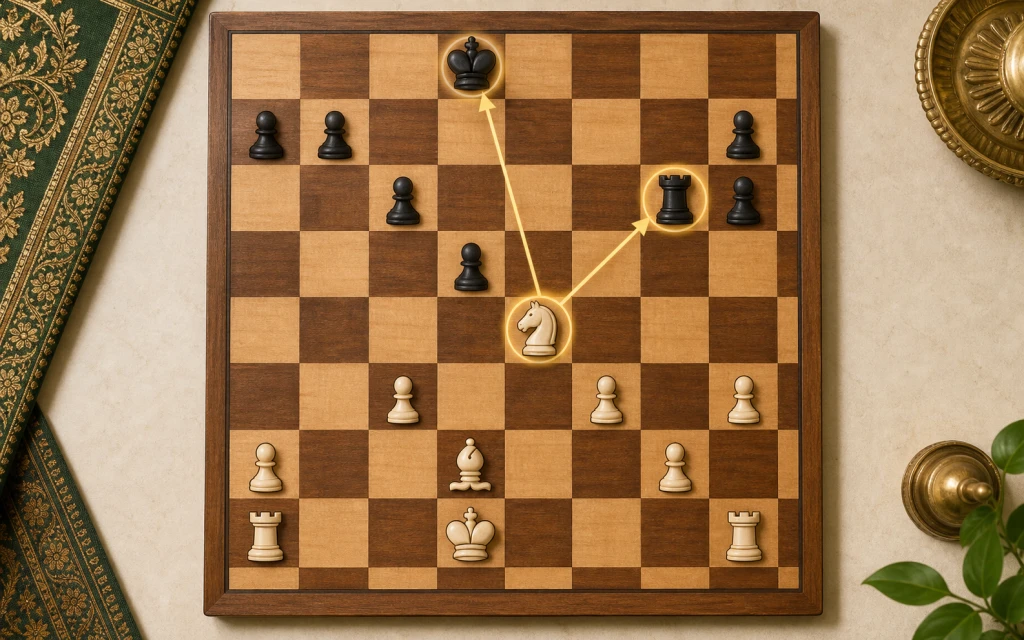
Chess Tactics for Kids: The Complete Guide to Winning Material#
By Coach Hrdyansh Pandey · Last updated 16 July 2026
If I could give every beginner student one piece of advice, it would be this: learn tactics before almost anything else. Openings, endgames, and long-term strategy matter — but below roughly 1500 Elo, tactics decide most kids’ games. A child who can spot a fork, pin, or skewer will beat a peer who has memorised twenty opening moves but cannot see a two-move combination.
This guide is the sequence I use in live online sessions for ages 5–15: six core patterns, kid-friendly analogies, common mistakes, a worked coaching method for teaching forks, daily practice bands, and parent-facing tips. Pair it with the broader chess learning path for kids and a realistic chess practice plan. ChessWize, the academy behind this article, is live online only — no physical centre — with FIDE-rated coaches, batches capped at six, and a free 30-minute demo if you want a coach to place your child.
Why tactics decide most kids’ games#
Direct answer: most junior games end because someone left a piece unprotected, missed a double attack, or walked into a pin or fork — not because one side had deeper opening theory.
When I review student games from school events and online rated play, the same story repeats. A child plays sensible development for ten moves, then hangs a Rook to a Knight fork or loses a Queen after ignoring a pin. That is not a lack of talent. It is a lack of trained eyes. Tactical pattern recognition is the skill of seeing threats and opportunities that the board already contains.
Three practical implications for parents:
- Tactics first beats openings first. Early opening study without tactical vision produces children who look prepared and still lose material on move twelve. Our best chess openings for kids guide still matters — after the child can spot simple forks and pins.
- Short daily puzzles beat weekend marathons. Pattern memory forms through spaced repetition. Ten focused minutes most days outperform one long Sunday puzzle binge. See also chess practice for kids at home.
- Live feedback closes the gap apps leave. Free tools on Lichess training and Chess.com tactics build volume. A coach watches how the child thinks — whether they scan for checks, captures, and threats before guessing. That is what live online chess coaching for kids in India is for.
If you are comparing self-study platforms for puzzles, our Chess.com vs Lichess for kids article walks through free versus paid puzzle workflows honestly.
The learning order I use in coaching#
I teach tactics in a fixed order because each motif reuses skills from the previous one:
- Fork — easiest to visualise; one piece, two targets.
- Pin — introduces immobilised pieces and alignment.
- Skewer — reverse of a pin; same alignment skill, different capture order.
- Discovered attack — one move reveals a second attacker.
- Double attack — broader family that includes forks plus mixed threats.
- X-ray — influence through an intervening piece; more abstract.
I do not dump all six on a seven-year-old in one week. A beginner may live on forks and absolute pins for a month of homework. An intermediate may cycle all six with multi-move setups. Advanced juniors work combinations where a pin enables a fork two moves later.
1. The fork#
Kid-friendly analogy: At a buffet, one fork spears two pieces of food at once. In chess, one piece attacks two (or more) enemy pieces at the same time.
How it works: Any piece can fork, but the Knight is the star for kids. Its L-shaped hop often attacks two pieces that cannot capture it back. The classic blow is Knight attacks King and Queen: the opponent must answer check, and the Queen falls next. Queen forks are also common because the Queen combines Rook and Bishop rays. Pawn forks (attacking two pieces on diagonals) appear constantly in beginner Italian Game positions after reckless piece placement.
Common beginner mistake: The child sees only one of the two attacks. I train a literal count: “How many enemy pieces does this move attack?” If the answer is two or more, pause and check values and safety.
Practice focus: On Lichess or Chess.com, filter puzzles by the fork theme. Start with one- and two-move solutions. Later add preparatory checks that force a piece onto a forking square.
Parent tip: After a lost game, ask only one question: “Was there a fork you missed?” That single review habit beats replaying the whole game badly.
2. The pin#
Kid-friendly analogy: A butterfly pinned to a board cannot fly away without tearing itself. In chess, a piece is pinned when moving it would expose a more valuable piece behind it.
How it works: Only long-range pieces create pins: Bishop, Rook, and Queen. Two types matter for kids:
- Absolute pin: The piece behind is the King. Moving the pinned piece would put the King in check, which is illegal under the FIDE Laws of Chess. The pinned piece is frozen.
- Relative pin: The piece behind is valuable (often Queen or Rook) but not the King. The pinned piece can move, but doing so usually loses material.
Common beginner mistake: Treating every pin as absolute. Children leave their King loose because they assume a relatively pinned Knight will never move — then the opponent sacrifices the Knight for a mating attack or a bigger capture.
Practice tip: Scan ranks, files, and diagonals for “stacked” enemy pieces: less valuable in front, more valuable behind, with your Bishop, Rook, or Queen able to step onto that line.
3. The skewer#
Kid-friendly analogy: If a pin pokes through a small piece toward a big one, a skewer attacks the big piece first. When the big piece steps aside, the smaller piece behind falls.
How it works: Again only Bishop, Rook, and Queen. The most common junior skewer I see is a Rook check on the back rank: King steps away, Rook captures the unprotected Rook or Bishop that was behind the King.
Common beginner mistake: Setting up the skewer without checking the opponent’s intermediate move. After the front piece flees, can they block with check, capture your attacker, or create a counter-threat? Always ask what happens between the check and your capture.
Link to pins: Teaching pin and skewer as a pair saves time. Same geometry, opposite priority of the two targets. Children who master both start seeing “lines” rather than isolated pieces — a big step toward intermediate play.
4. The discovered attack#
Kid-friendly analogy: A door opens. The piece that moved is not always the dangerous one — it cleared the path for the attacker standing behind.
How it works: A piece moves off a line and reveals an attack from a Bishop, Rook, or Queen behind it. If the revealed attack is check, it is a discovered check — one of the most powerful basic tactics, because the opponent must answer the check while the moving piece often captures free material or improves with tempo.
Why kids love it: It feels like a trick play. More importantly, it teaches that pieces work as a battery, not as lone heroes. That team idea later supports Italian Game attacks with Bishop and Queen aimed at f7, and Rook lifts behind pawns.
Coaching cue I use: “Before you move a piece, ask what you uncover behind it — friend or enemy.”
5. The double attack#
Kid-friendly analogy: Two problems at once. The opponent has one move and cannot fix both.
How it works: A double attack is any move that creates two threats simultaneously. Forks are the cleanest type. The wider family includes: attack a piece and threaten mate; attack a piece and threaten promotion; check while attacking an unprotected piece elsewhere. Queens excel here because they threaten along ranks, files, and diagonals in one move.
Why it matters in junior chess: Almost every under-12 game I annotate contains at least one missed double attack — either the winner failed to spot one earlier, or the loser failed to defend against one. Training double attacks is training candidate moves: not “what do I want to do?” but “what move creates two headaches?”
Training approach after each tournament game: Mark every position where a double attack existed for either side. Use the child’s own games first; personal pain teaches faster than random puzzles. For broader rating-focused work later, see how to improve a child’s chess rating — always process over promised point jumps.
6. The X-ray#
Kid-friendly analogy: X-ray vision. Your Rook, Bishop, or Queen “sees through” a piece to a square behind it.
How it works: A long-range piece defends or attacks through an intervening unit. Example: a Rook on a1 still influences a8 if the piece on a4 moves away. X-rays matter in exchanges (“I recapture through your piece”) and in back-rank mates where a Rook defends a key square through its own piece until that piece moves with tempo.
Why I teach it last: It requires visualising the board without the middle piece. That abstraction usually lands better after forks, pins, and discoveries feel automatic — often around ages 10–11 for children who have already been playing structured games, though timing varies widely. No age rule is universal.
Deep dive: how I teach the Knight fork in a live session#
Parents often ask what a tactics lesson looks like on a shared online board. Here is the 20–25 minute block I run for a student who already knows piece moves and check — so you can copy it at home or recognise it in a demo.
I start with an almost empty board: White Knight on f3, Black King on e8, Queen on d8, Rook on a8. I do not open a cluttered master middlegame. Clutter hides the pattern. First prompt: “Your Knight jumps in an L. Show me every square it can land on from f3.” Many children still misdraw the L under pressure, so this warm-up is load-bearing.
Next I place the Knight on e5 and ask which Black pieces it can attack in one move. Then I rearrange into clean geometry where the Knight can hit King and Queen together. I never name the tactic first. I ask: “Can the Knight go somewhere that attacks both the King and the Queen?” When they find the square themselves, the idea sticks. If I lecture the definition first, they nod and forget.
Only after they land the move do I name it: one piece, two targets, and if one target is the King, the other usually falls. I immediately flip colours and force defence. A Black Knight forks their Queen and Rook. Beginners often move the Queen and leave the Rook, or capture the Knight with a piece that is pinned or loose. We repair the decision tree: is the forking piece safe to take; can one attacked piece move and defend the other; if not, which loss is smaller. Defending forks builds the same pattern memory as delivering them.
Then comes a preparation move: a check that forces the King onto a square where the Knight fork appears next. That is the jump from seeing a ready-made fork to creating one. Most children need several examples before they stop scanning only the present position. I watch attention as carefully as accuracy — ages 5–15 on live video tire fast. If a seven-year-old is fading, I stop at one successful prep-move puzzle rather than forcing five more.
Homework is narrow: about ten Knight-fork puzzles only on Lichess or Chess.com, theme-filtered. Mixed sets too early train guessing. Parents can pause one slow home game whenever a Knight could check — “freeze and count attacks.” In a ChessWize group (max six) each child answers before I reveal. Formats and published prices: 1:1 ₹1,000 for blind-spot work, two-on-one ₹550 for sibling attacker/defender turns, group from ₹375, starter pack ₹2,500 for eight classes. Online only, English or Hindi, same coach weekly, refund on unused classes under plan terms. The free 30-minute demo checks forks-readiness versus rules work from chess rules for kids.
I will not attach a calendar promise to this drill. Tactics show first as fewer free pieces lost, then better school-event results, and only later — after enough rated games — as a stable rating. AICF list publication time is administrative, not a skill claim. Session goal: find, name, and defend one clean Knight fork without guessing.
How to practice tactics daily#
Tactics behave like a language: daily contact keeps patterns fluent; long gaps make them rusty.
Beginners (unrated to about 600 Elo)
- About 10 puzzles per day, puzzle rating roughly 400–800
- Themes: forks and basic pins only at first
- 1–2 minutes of thinking before the first click
- Total time: 15–20 minutes
- One slow game afterwards is enough
Intermediate (about 600–1200)
- 15–20 puzzles per day, roughly 800–1400
- All six motifs over the week, not necessarily every day
- 2–3 minutes per puzzle; no random clicking
- Total time: 30–45 minutes including a short game review
Advanced juniors (roughly 1400+ competitive track)
- 20–30 puzzles, including multi-move combinations
- Mix themed sets with mixed sets
- Timed sets only after accuracy is stable — speed without accuracy teaches panic
- Total time: 30–60 minutes, still leaving room for endgames and openings
Golden rule: If the child did not see the full idea before the first move, the puzzle mostly trained fingers. I say this in class often: calculate, then move.
For platform choice and parental controls, revisit Chess.com vs Lichess for kids. For balancing puzzles with school homework in CBSE or other boards, use the weekly templates in the chess homework and practice plan.
How tactics fit openings and endgames#
Tactics are not a separate school subject from the rest of chess.
In the opening, children who know Scholar’s Mate patterns, Legal’s Mate ideas, and Fried Liver motifs from Italian Game positions convert opening principles into actual points. That is why openings study without tactics is hollow — covered in best chess openings for kids.
In the endgame, forks and skewers appear with fewer pieces and less hiding space. King and Pawn races create Knight fork motifs on the way to promotion. Basic checkmate patterns sit next to tactics in basic chess endgames for kids.
In tournaments, time pressure multiplies tactical errors. Clock skills and formats are a separate topic (chess time controls for kids), but the cure for blitz blunders is still slower puzzle calculation in training, not more panic games.
Expert tips from live online coaching#
These are the tips I give parents after demos and first-month reviews:
- Theme-lock homework for two weeks. If the child is weak on pins, do not assign mixed puzzles. Assign only pins until accuracy rises. Mixed sets too early reward lucky guesses and hide the hole.
- Force a spoken candidate move. Before they click, they must say: “I am looking at checks, captures, threats.” Out loud. Silent rushing is the main failure mode I see on shared screens.
- Review losses for one motif only. After a tournament round, pick a single question (“Where was the fork?”) instead of a 40-minute post-mortem. Short reviews happen; long ones get postponed forever.
- Protect sleep before events. A tired child misses one-move hangings regardless of puzzle rating. Tactics training does not override basic rest before a Sunday AICF-style schedule.
- Use the coach for process, the app for volume. Apps supply unlimited positions. The coach should watch calculation habits, not compete with the puzzle database on quantity.
If you want a human to set that theme-lock plan, browse ChessWize courses, meet the coaching team, or compare formats on the compare page. Families in metro areas often start from local landing pages such as online chess classes for kids in Mumbai, Delhi NCR, or Bengaluru — same online delivery, same batch cap of six, ages 5–15, free 30-minute demo.
What parents should not do#
- Do not equate puzzle rating with tournament strength. Puzzle scores inflate when children retry and pattern-match the site’s style.
- Do not punish wrong puzzles. Fear produces faster guessing, not deeper calculation.
- Do not buy five tactics books at once. One clear digital workflow plus a coach’s weekly theme beats an unread shelf.
- Do not skip endgames entirely. Tactics win material; endgames convert it. Keep a thin weekly endgame slot.
- Do not trust miracle claims. Be wary of any programme that promises fixed rating jumps or set improvement calendars. Skill work is measurable; calendar promises are marketing.
ChessWize’s published commercial facts for context only: group sessions from ₹375, two-on-one ₹550, 1:1 ₹1,000 per session, starter pack ₹2,500 for eight classes, 5.0 on Google from 21 reviews, refund on unused classes under plan terms, complimentary 30-minute demo. Those are programme terms, not proof that tactics homework will move a rating by a set amount.
Frequently Asked Questions#
What is the most important chess tactic for kids to learn first?#
The fork. It is the most common tactical pattern in children’s games, it applies to every piece, and learning forks builds the habit of counting how many enemy pieces a move attacks. That habit transfers to pins, skewers, and discoveries later.
How many tactics puzzles should kids solve daily?#
Start with about 10 carefully solved puzzles a day. That fits most school schedules and builds a habit. Increase to 15–20 when attention and enjoyment allow. Ten puzzles solved by calculation beat fifty rushed clicks.
What is the difference between a pin and a skewer?#
In a pin, the less valuable piece sits in front and is held because a more valuable piece is behind it. In a skewer, the more valuable piece is in front and must move, exposing a lesser piece behind it for capture. They are mirror images of each other.
When should kids start tactical training?#
As soon as they know how the pieces move and understand check and checkmate. There is no minimum rating requirement. In live coaching I usually introduce simple forks and pins by the second or third session once the rules feel settled.
Are free puzzle sites enough, or do kids need a coach for tactics?#
Puzzle sites such as Lichess and Chess.com are excellent for volume. A coach helps when the child keeps missing the same motif, guesses instead of calculating, or needs tactics woven into openings and real games. Many families use both.
Which piece delivers the most forks in kids’ games?#
The Knight. Its L-shaped hop often attacks two pieces that cannot capture it back. Knight forks on King and Queen, King and Rook, or Queen and Rook decide many junior games, so I prioritise Knight forks early in training.
Next reading#
Hrdyansh Pandey
Day-to-day coach at ChessWize. 7+ years training students aged 5–15 across India, the USA, the UK, Singapore, Australia, and the Middle East. Known for structured, interactive sessions that turn nervous beginners into tournament-ready players.
View FIDE ProfileReferences & Sources
- [01] Chess tactics (fork, pin, skewer, discovered attack, and related motifs) are catalogued in the standard chess tactics overview — https://en.wikipedia.org/wiki/Chess_tactics, verified 2026-07-16
- [02] Lichess offers free unlimited tactical puzzles with theme filters and adaptive difficulty — https://lichess.org/training, verified 2026-07-16
- [03] Chess.com publishes a tactics primer covering forks, pins, skewers, and discovery themes for improving players — https://www.chess.com/terms/chess-tactics, verified 2026-07-16
- [04] The FIDE Laws of Chess define check, capture legality, and absolute constraints that make absolute pins illegal to break — https://www.fide.com/FIDE/handbook/LawsOfChess.pdf, verified 2026-07-16
- [05] AICF is the national federation running rated junior events where tactical skill decides most games under roughly 1500 — https://aicf.in/, verified 2026-07-16