On this page
A parent's guide to India's major chess championships: National Schools, AICF Nationals, Asian Youth, and World Cadets, with qualification paths.

Day-to-day coach at ChessWize. 7+ years training students aged 5–15 across India, the USA, the UK, Singapore, Australia, and the Middle East. Known for structured, interactive sessions that turn nervous beginners into tournament-ready players.
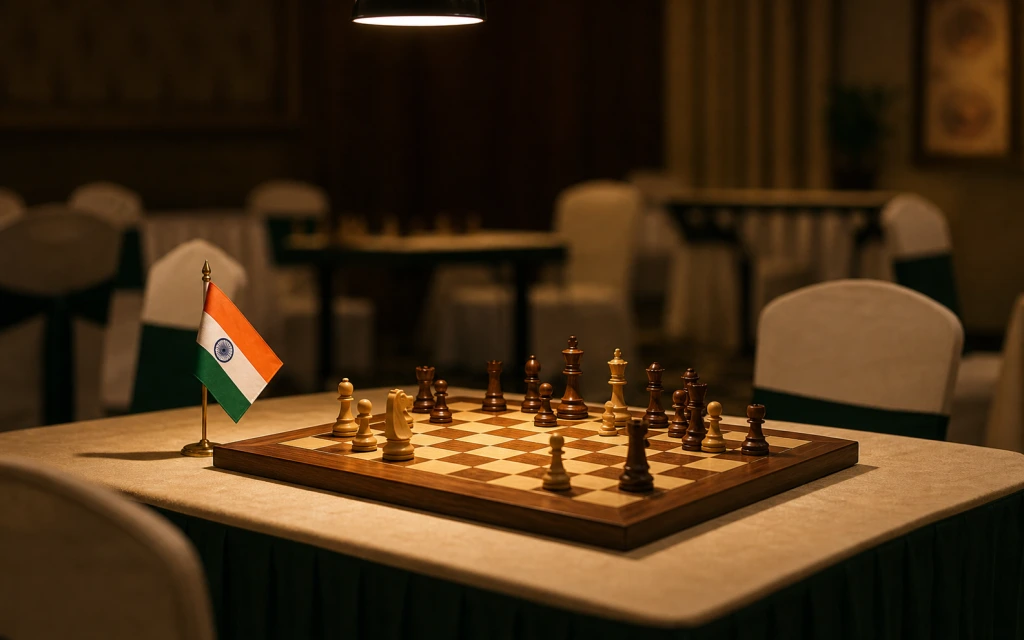
National Schools, Asian Youth, and World Cadets: The Championship Pathway#
By Coach Hrdyansh Pandey · FIDE-rated coach at ChessWize · Last updated 16 July 2026
Once your child has played local and district tournaments, the honest map of what comes next has four tiers: the National Schools Championship (via SGFI and AICF), the AICF National Championships, the Asian Youth Championship (via the Asian Chess Federation), and the World Cadets run by FIDE. Each has its own entry route, cost, and rating impact.
In seven years of coaching kids online — students in the USA, UK, Singapore, Australia, and the Middle East — the question I hear most from ambitious parents is not “will my child win?” It is “what is the actual path, and what does each step cost?” This guide answers that for each event: what it is, how to qualify, what to expect, and how to prepare. I will also be blunt about the parts marketing pages skip: cost, the odds, and why most children never reach the top tier, which is normal and not a failure.
Event comparison table#
| Event | Organiser | Age categories | Pathway | FIDE rated? | Approx. cost |
|---|---|---|---|---|---|
| National Schools | SGFI + AICF | U-9, U-11, U-14, U-17, U-19 | School → District → State → National | Sometimes | ₹5,000–₹15,000 |
| AICF Nationals | AICF | U-7, U-9, U-11, U-13, U-15, U-17 | State championship qualification | Yes | ₹10,000–₹30,000 |
| Asian Youth | Asian Chess Federation | U-8, U-10, U-12, U-14, U-16, U-18 | AICF selection (performance based) | Yes | ₹50,000–₹2,00,000+ |
| World Cadets | FIDE | U-8, U-10, U-12 | AICF selection (top national performers) | Yes | ₹1,00,000–₹3,00,000+ |
Costs above are broad planning ranges for registration, travel, and stay — not fixed fees. Read every official circular for the exact figures, because they change each year and by host city. For the earlier rungs of this ladder, start with our guide to a child’s first chess tournament in India and the full chess tournament and rating pathway.
National Schools Chess Championship#
The National Schools Championship is conducted by the School Games Federation of India (SGFI) in association with AICF. It is the primary school-based chess competition in India, and it runs parallel to — but separate from — the AICF national pathway. The distinction matters, because the two use different entry routes.
Qualification pathway:
- School level — the school enters the child in its team or individual event.
- District level — school winners advance to the district competition.
- State level — district winners compete at the state round.
- National level — state winners represent their state at the National Schools Championship.
Key details:
- Age categories: U-9, U-11, U-14, U-17, and U-19.
- Both individual and team events run.
- Many schools back chess because it adds to their sports portfolio and to school admissions credentials.
The distinction to remember: the National Schools route is school-driven — the school must register the child. The AICF route is player-driven, through the state chess association. Plenty of children compete in both in the same season, and there is no rule against it.
AICF National Championships#
These are the annual national championships organised directly by AICF in age-specific categories: U-7, U-9, U-11, U-13, U-15, and U-17, plus Open and Women’s sections.
Qualification: most categories require qualifying through the state championship. Top finishers at state level — often the top five to ten — earn the right to represent the state at Nationals. Some events accept any AICF member above a minimum rating.
What to expect:
- 9–11 rounds of Swiss pairing at classical time controls.
- Large fields — India’s junior participation is enormous, and popular age groups draw several hundred players.
- FIDE-rated, so results feed your child’s international rating and Elo.
- Roughly 7–10 days including rest days, hosted in a different city each year.
Preparation timeline: for a student’s first Nationals I plan two to three months of focused work:
- Weeks 1–4: harder tactics training at a difficulty that stretches without crushing.
- Weeks 5–8: opening tidy-up — refine the existing repertoire rather than learn new lines late.
- Weeks 9–12: endgame practice, mock games at the real time control, and — importantly — rest.
Asian Youth Chess Championship#
The Asian Youth Championship is organised by the Asian Chess Federation and gathers the strongest juniors across the continent. For an Indian child it is usually the first real taste of international competition — a step up in strength, and in nerves.
How to qualify: AICF selects the Indian team using national championship results, current FIDE rating, and its published selection criteria, which can include a selection tournament. Selection is competitive — only a small number per age category are chosen — and the exact rules can shift year to year, so treat the current AICF circular as the source of truth rather than last year’s process.
What to expect:
- Opponents from China, Uzbekistan, Vietnam, the Philippines, Kazakhstan, and other chess-strong nations.
- FIDE-rated with a strong rating effect because the average opponent is strong; a good run can move a child’s rating meaningfully, though I never promise a number.
- Held in a different Asian country each year, across 7–10 playing days plus travel.
- Real cultural exposure — many parents tell me the travel and the friendships matter as much as the results.
Preparation differences: international fields play different openings and carry different tactical styles from what a child meets at home. Studying recent Asian Youth games helps set expectations, and light opponent preparation starts to matter here for the first time. This is also where improving a child’s rating becomes a planned project rather than a hope.
Costs: budget ₹50,000–₹2,00,000 or more for registration, international flights, accommodation, meals, and incidentals. Some state associations and sponsors part-fund selected players, but coverage varies widely, and I have seen strong families miss out simply because they applied for support too late. Start sponsorship enquiries — federations, corporates, school sports funds — the moment selection looks realistic.
World Cadet Chess Championship#
The World Cadets Championship is FIDE’s premier event for the youngest players, with categories U-8, U-10, and U-12. Strong results here can earn FIDE titles such as CM or FM and are, historically, an early marker for players who later reach the top.
How to qualify: selection rests on AICF’s assessment of the strongest juniors in each age category, typically weighing national results and FIDE rating, and it may involve a specific selection event.
Historical context: India has produced World Cadet medallists, and the event has long been a proving ground for future Grandmasters. Fields run to roughly 100–200 players per age category from 50-plus countries — a genuinely global room.
Costs and logistics: World Cadets is held in a different country each year (recent hosts span Europe, South America, and Asia). Plan for international flights, 10–14 nights of stay and meals, visa processing and travel insurance (start visas two to three months early), and registration — a realistic total of ₹1,00,000–₹3,00,000+ depending on the host. One practical tip from experience: book a hotel close to the venue. Cadet days start early and finish late, and a tired child who commutes an hour each way plays a level below their real strength.
Deep dive: how I actually prepare a student for their first Nationals#
This is the part parents ask me to spell out, so here is my real method rather than a slogan. When a student first qualifies for an AICF National, I do not touch openings in week one. I open their own game archive and look for the pattern that is quietly costing them points.
Step 1 — diagnosis before content. I take twenty to thirty of the child’s recent slow games and sort the losses into four buckets: calculation slips, concept gaps (they did not understand the position type), clock trouble, and nerves. Most children have one bucket that is far heavier than the rest. One of my students kept losing winning endgames — not from weak endgame knowledge, but because he was already mentally celebrating and stopped calculating. That is a clock-and-attention problem, not an endgame syllabus problem. Fixing the wrong bucket wastes the two months you have.
Step 2 — narrow, deliberate tactics. For weeks one to four I set tactics at a difficulty where the child solves roughly seven of ten. Too easy builds false confidence; too hard trains guessing. I care less about volume than about the child explaining why the move works before moving. In a live session I will stop them and ask, “what is Black’s threat if you do nothing?” That single habit — checking the opponent’s idea first — prevents more blunders than any opening file.
Step 3 — openings only as tidy-up. Nationals is not the time to learn a new defence. I keep the child’s existing repertoire and remove the two or three lines where they routinely get a bad position out of the opening. The goal is to reach a playable middlegame in every game, not to memorise novelties a nine-year-old will forget under pressure.
Step 4 — simulate the real thing. In the final month we play full-length games at the actual classical time control, with notation, on a physical board where possible. Children who only train online often freeze when they must write moves, press a real clock, and sit for two hours. We rehearse the boredom, the long think, and the recovery routine after a loss — because a nine-round Swiss is won by the child who bounces back on the same day, not the one who never loses.
Step 5 — the parent’s job. I brief parents to protect sleep, food, and a calm morning, and to say the same sentence after every game regardless of result: “tell me one good move you found.” That keeps the child’s focus on thinking, not on the scoreboard, which is exactly what carries them through the back half of a long event.
None of this assures a result — no honest coach can promise that. What it does is make sure the child arrives prepared for the format, not just the moves. If you want to see how this structure runs week to week, our online chess classes for kids page walks through the lesson plans, and you can meet the coaches who deliver them.
Building the pathway: a realistic timeline#
- Year 1: learn fundamentals, play first tournaments at school and district level, earn a first AICF rating. Target: 800–1000.
- Year 2: compete regularly at district level, attempt a first state championship, build tactics and endgame foundations. Target: 1000–1200.
- Year 3: compete seriously at state level, aim for a top-10 state ranking, begin real opening prep. Target: 1200–1400.
- Year 4+: play AICF Nationals; if results warrant, enter the AICF selection pool for Asian Youth and World Cadets. Target: 1400+.
Reality check: fewer than one in twenty competitive juniors reaches the Asian Youth or World Cadets level. That is not failure — it reflects how deep Indian junior chess is. Every rung of this ladder delivers competitive experience, resilience, and cognitive growth regardless of how far a child eventually climbs.
Expert tips from the coaching chair#
- Read the circular yourself. Age eligibility cut-off dates, rated-or-not status, and byes are all decided by the circular, not by rumour in a parent WhatsApp group. I have seen children turn up in the wrong age category over a one-week birthday cut-off.
- Enter one unrated warm-up before a rated event. A local rapid the fortnight before Nationals settles nerves and surfaces any opening hole while there is still time to patch it.
- Train the recovery, not just the win. Practise the ten minutes after a loss — a walk, water, a snack — because a nine-round event is decided by how fast a child resets.
- Start travel logistics early for international events. Visas, insurance, and venue-adjacent hotels sell out. Begin two to three months before an Asian Youth or World Cadets trip.
- Keep one slow game a week even in exam season. Rating grows from calculation under real time, not from a hundred blitz games. See our note on time controls and formats.
Frequently asked questions#
What is the difference between National Schools and AICF Nationals?#
National Schools is school-based — your school registers the child under SGFI’s structure with its own age groups. AICF Nationals is registered individually through your state chess association. Both are national events, but AICF Nationals usually draws the stronger field because entry does not depend on which school a child attends.
Do school chess events give an AICF rating?#
Some do, some do not. National-level school finals are often AICF-rated, while many district and state school rounds are not. Always read the event circular before you travel, because rated and unrated events change how much a result matters for your child’s rating file.
How do I know if my child is ready for Nationals?#
If your child has finished around the top ten at their state championship and holds an AICF rating above 1200, they are ready to compete at Nationals. They may not win, but they will gain real experience against the country’s strongest juniors in their exact age group.
How are Indian players selected for Asian Youth and World Cadets?#
AICF selects the Indian contingent using national championship results, current FIDE rating, and published selection criteria that can include a selection tournament. Only a handful of players per age category are chosen, so selection is competitive and criteria can change year to year — check the AICF circular.
How much do international junior events cost?#
Budget widely. Asian Youth and World Cadets involve international flights, ten to fourteen nights of accommodation, meals, visa and insurance, plus registration. Families should plan for roughly ₹1,00,000–₹3,00,000 or more depending on the host country. Some state bodies or sponsors part-fund selected players, but coverage varies.
Does my child need a coach to reach the national pathway?#
No child needs paid coaching to enter local or district events. A coach becomes useful once the goal is a state or national qualification, because opponent preparation, time-control practice, and a planned schedule are hard for a parent to build alone. Many families combine self-study with a weekly coach — see is online chess coaching worth it?.
Sources#
- All India Chess Federation — https://aicf.in/ (verified 16 Jul 2026)
- All India Chess Federation (background) — https://en.wikipedia.org/wiki/All_India_Chess_Federation (verified 16 Jul 2026)
- World Cadets Chess Championship — https://en.wikipedia.org/wiki/World_Cadets_Chess_Championship (verified 16 Jul 2026)
- Asian Chess Federation — https://asianchess.com/ (verified 16 Jul 2026)
- FIDE — https://www.fide.com/ (verified 16 Jul 2026)
Back to the parent hub: chess tournament and rating pathway in India.
See also: AICF tournaments for beginners · FIDE rating and Elo for kids · chess and school admissions · how to improve your child’s chess rating
Ready to plan a competitive season? Compare our structured plans on the courses page or book a complimentary demo.
Hrdyansh Pandey
Day-to-day coach at ChessWize. 7+ years training students aged 5–15 across India, the USA, the UK, Singapore, Australia, and the Middle East. Known for structured, interactive sessions that turn nervous beginners into tournament-ready players.
View FIDE ProfileReferences & Sources
- [01] The All India Chess Federation is the national governing body affiliated to FIDE — aicf.in, verified 2026-07-16
- [02] FIDE organises the World Cadets Chess Championship for players under 8, 10, and 12 — en.wikipedia.org/wiki/World_Cadets_Chess_Championship, verified 2026-07-16
- [03] All India Chess Federation — history and role as national federation — en.wikipedia.org/wiki/All_India_Chess_Federation, verified 2026-07-16
- [04] The Asian Chess Federation is FIDE's continental body for Asia and runs the Asian Youth Championship — asianchess.com, verified 2026-07-16
- [05] FIDE is the international chess federation governing world title events — fide.com, verified 2026-07-16