On this page
Does chess help with math? The five mathematical skills it builds, what the research actually shows, and honest coaching advice for Indian parents.
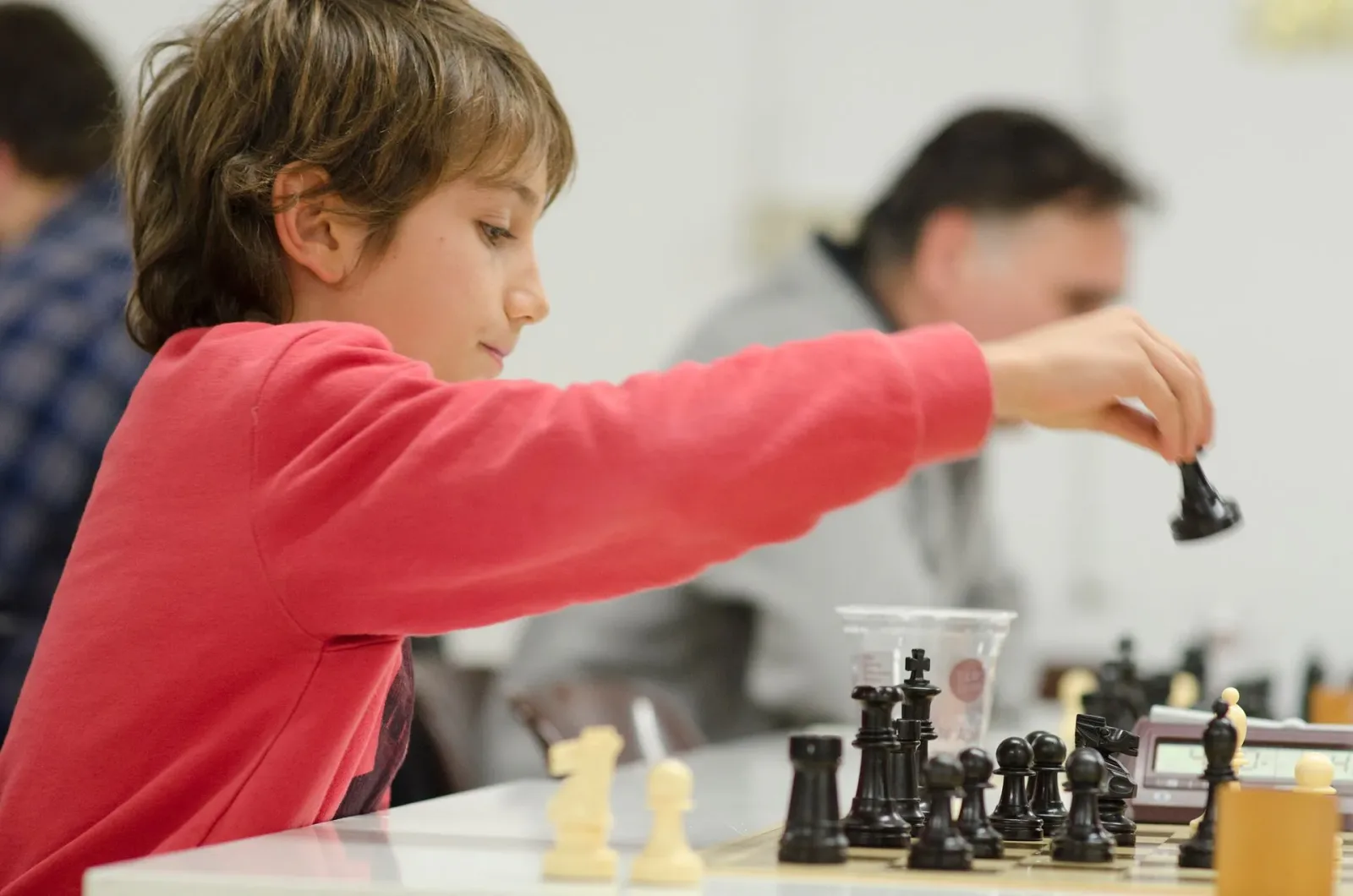
Chess and Math Skills for Kids: What the Connection Actually Looks Like#
By Coach Aryan Pal · Last updated 16 July 2026
Chess helps with maths, but modestly and indirectly. It develops five thinking skills — pattern recognition, spatial reasoning, multi-step calculation, probability estimation and optimisation — that overlap with school mathematics. It does not teach algebra, replace a maths tutor, or lift Board exam scores on its own. The honest version is more useful than the marketing one, so here it is.
“Chess makes kids better at maths” is a claim I hear from parents, other coaches, and academy adverts almost daily. It is partially true. What chess does do is build specific mathematical thinking skills that transfer to the classroom. Understanding which skills, and how they transfer, beats vague promises that “chess makes kids smarter.” If you are weighing chess against other enrichment, read this alongside our chess benefits for kids overview and the honest does chess improve focus guide.
The Five Mathematical Skills Chess Develops#
1. Pattern Recognition#
Pattern recognition is fundamental to both chess and mathematics. In chess, experienced players recognise tactical patterns — forks, pins, skewers, discovered attacks — rather than calculating every position from scratch. They see a configuration of pieces and immediately identify the underlying pattern.
In maths, the same skill applies to algebraic patterns, number sequences, geometric relationships and function behaviour. A child trained to recognise patterns on a board approaches maths problems with the same instinct — looking for familiar structures rather than solving every problem from first principles.
From my coaching: I give students a position with a hidden knight fork. Students who have seen 50+ fork puzzles spot it in seconds. The same students often tell me they recognise patterns faster in maths class too — particularly in sequences, series and geometric proofs.
2. Spatial Reasoning#
Chess is played on an 8x8 coordinate grid. Every move involves spatial relationships — distances between pieces, diagonal lines, file and rank geometry, and the way pieces control squares in two dimensions.
This maps directly onto coordinate geometry, graph reading and spatial-reasoning questions in the CBSE and ICSE maths curricula. Children who play chess build an intuitive grasp of grid-based relationships that transfers to graphing, coordinate geometry and data-interpretation questions.
On Lichess and Chess.com, puzzle training often means visualising piece movements without touching the board — a form of mental spatial manipulation that strengthens the same circuits used in geometric reasoning.
3. Calculation and Evaluation#
Chess requires multi-step calculation: “If I move here, they move there, then I take, they recapture, and I fork.” This is sequential, conditional logic — the same structure as multi-step word problems.
Children who practise calculation grow comfortable with chains of conditional reasoning and holding intermediate results in working memory. That is exactly the skill required for multi-step algebra, geometric proofs and combinatorics.
Key distinction: Chess calculation is faster and more intuitive than formal maths calculation. Children who struggle with the procedural side of maths (showing work, writing equations) may still excel at chess because chess allows intuitive leaps that formal notation does not. The transfer is in thinking skill, not in notation.
4. Probability Estimation#
Experienced players decide under uncertainty: “There are three reasonable replies here. If they play A, my plan works. If B, I adjust. If C, I am in trouble.” Weighing scenarios and choosing the move that is best across the most likely outcomes is informal probability estimation, analogous to basic probability and risk assessment in maths.
Chess does not teach formal probability theory, but it builds the intuition — the understanding that outcomes are uncertain and that decisions should account for multiple possibilities.
5. Optimisation#
Every move is a trade-off. Aggressive moves gain attacking chances but create weaknesses; moving a piece to an active square means it stops guarding another. This constant trade-off analysis is optimisation — finding the best available option under constraints.
Optimisation runs throughout advanced mathematics (linear programming, calculus maxima and minima) and practical quantitative reasoning. Children who develop optimisation thinking through chess meet these problems with the right mental framework, even before they learn the formal tools.
What the Research Actually Shows#
Here honesty matters, because this is where marketing usually overreaches. Sala and Gobet’s 2016 meta-analysis of chess instruction found a small-to-moderate positive effect on mathematics achievement — around d ≈ 0.38. That is a real, encouraging finding.
But the same researchers, and follow-up work, added a crucial caveat: the effect shrinks as study design improves. When a 2017 study used an active control group — where the comparison group did another structured cognitive activity rather than nothing — chess did not significantly outperform the alternative. Their broader meta-analytic review found transfer effects were inversely related to design quality. In plain terms: some of the measured maths gain likely comes from the discipline, teacher attention and cognitive engagement of any structured enrichment — not chess specifically.
I discussed the same pattern in our focus guide, and it is worth repeating: chess is an effective tool for building mathematical thinking, but it is not magically superior to other structured activities for lifting maths scores. Choose chess because your child enjoys it and will stick with it, and treat the maths benefits as a genuine bonus rather than the reason. Resources like ChessBase India are great for keeping that enjoyment alive.
How I use one position to teach three maths skills#
Parents sometimes watch a session and ask, “How is this maths? They’re just playing.” So let me walk through a single teaching moment I use constantly, because it shows the connection better than any study can.
I set up a position where my student’s knight can jump to a square that attacks the opponent’s king and rook at once — a fork. Before they move, I stop them and ask three questions in order, and each one is quietly a different maths skill.
First: “Have you seen this shape before?” That is pattern recognition. A child who has drilled fork puzzles recognises the L-shaped knight geometry instantly, exactly the way a child who has practised enough recognises that 49 is a perfect square without dividing. I am training the eye to match structures, not to compute from zero.
Second: “If you play the fork, what are all the replies?” Now we are doing conditional calculation. We list them together — the king can move, or a piece can block, or they can counterattack. For each branch we play it out a move or two in our heads. This is the same working-memory move a child makes in a multi-step word problem: hold the intermediate result, compute the next step, do not lose the thread. Children who freeze at “if x, then… and then…” in maths often freeze here too, and watching them do it on the board tells me precisely where their working memory gives out.
Third: “So which reply is most likely, and is the fork still worth it?” That is probability and optimisation together. We are not certain what the opponent will do, so we weigh it: the reply that saves the rook is the likely one, so we check whether we still come out ahead after it. If yes, the fork is optimal; if the opponent has a nasty counterattack in one branch, maybe a quieter move scores better. The child learns to choose under uncertainty and to accept a trade-off — the exact reasoning behind risk questions and optimisation problems later in school.
The reason this works is that the child is not sitting through a lecture on conditional logic; they are trying to win, and the maths is smuggled inside the fun. I have seen a nine-year-old who “hates maths homework” happily calculate a five-move sequence three times over because a rook was on the line. That is the transfer worth having — not a guaranteed exam mark, but a child who has quietly practised thinking in steps, weighing odds, and choosing the best option under constraints. You can see how we build this into structured lessons on our courses page, or judge it yourself in a free demo.
Chess vs Math Tutoring: The Honest Comparison#
Parents ask me: “Should I spend that hour on chess or on maths tutoring?” It depends on the child:
If your child struggles with maths procedures (carrying over, solving equations step by step, memorising formulas), maths tutoring produces faster, more direct improvement. Chess does not teach procedures. A child who cannot solve 2x + 5 = 15 will not learn to by playing chess — they need direct instruction for that.
If your child struggles with mathematical thinking (understanding why a formula works, visualising geometric relationships, tackling unfamiliar problems logically), chess can be as valuable as extra tutoring because it develops the underlying cognitive skills. These children often “get stuck” on unfamiliar problem types because they rely on memorised procedures rather than understanding.
If your child dislikes maths, chess has a unique advantage. Some children who resist worksheets engage enthusiastically with chess because it presents mathematical thinking through play. That can build positive associations with logical thinking that later transfer to the classroom. I have seen it repeatedly — a child who “hates maths” discovers they love calculating variations, and that confidence gradually reaches their maths class.
The ideal combination: structured maths practice for procedural fluency + chess for mathematical thinking. They complement rather than compete. If schedule and budget allow only one, choose by your child’s specific weakness — procedures → maths tutor; thinking and reasoning → chess is genuinely competitive. For families weighing chess against school priorities, our chess for school admissions and best age to start chess guides help you time the investment.
Coach tips: getting the maths benefit from chess#
- Make the child explain the “why.” After a move, ask “why that one?” Verbalising the reasoning is where the transfer to maths thinking actually happens.
- Prioritise slow puzzles over fast games. Calculation grows under longer time controls, not in one-minute blitz. Blitz is fun; it is not where the thinking muscle builds.
- Connect the board to the notebook. When your child spots a pattern in chess, point out the same instinct in a maths problem that week. The link is not automatic — naming it helps.
- Don’t sell chess as a maths shortcut. Let the child enjoy chess for chess. Framing it as “extra maths practice” is the fastest way to kill the enjoyment that makes the benefit possible.
- Keep maths teaching separate. Chess supplements; it does not replace. Protect your child’s actual maths practice and tuition — chess is the bonus, not the plan.
Frequently Asked Questions#
At what age does the chess-math connection appear?#
Children as young as 6 can start developing pattern recognition and spatial reasoning through chess. The maths performance benefits become measurable around ages 8–10, when the curriculum introduces topics — coordinate geometry, multi-step problems, logical reasoning — that overlap with chess-trained skills.
Does chess help with Board exams specifically?#
Indirectly, yes. Board maths tests pattern recognition, spatial reasoning, multi-step calculation and logical deduction — all skills chess develops. However, direct exam preparation (past papers, formulas, a maths tutor) is essential and should not be replaced by chess.
Can my child learn math through chess?#
Chess is not a maths curriculum. It develops mathematical thinking but teaches no specific content (fractions, algebra, trigonometry). Think of chess as cognitive training that makes your child a better maths learner, not a replacement for maths instruction.
My child hates maths but loves chess — does that help?#
Often, yes. Some children who resist worksheets happily calculate long chess variations, and that confidence in logical thinking can slowly transfer to the classroom. It is one of the most consistent patterns I see in coaching — though it works alongside good maths teaching, never instead of it.
Is chess better than other activities for maths?#
The research says not clearly. When chess is compared against another structured activity (rather than nothing), its specific advantage for maths largely disappears. Choose chess because your child enjoys and sticks with it; the maths benefit is a real bonus, not a unique superpower.
Sources#
- Sala & Gobet, effects of chess instruction (Frontiers) — https://www.frontiersin.org/articles/256030 (verified 16 Jul 2026)
- Chess instruction with an active control group (PubMed) — https://pubmed.ncbi.nlm.nih.gov/28646322/ (verified 16 Jul 2026)
- Mathematics and chess (Wikipedia) — https://en.wikipedia.org/wiki/Mathematics_and_chess (verified 16 Jul 2026)
- Sala & Gobet meta-analysis (LSE eprints) — http://eprints.lse.ac.uk/102237/ (verified 16 Jul 2026)
- ChessBase India — https://chessbase.in/ (verified 16 Jul 2026)
Back to parent hub: Chess benefits for kids. Want to see the thinking in action? Book a free 30-minute demo or explore online chess classes for kids and the ChessWize coaches.
See also: Does chess improve focus? · Chess for school admissions
Return to the main hub: Online chess coaching for kids in India.

Aryan Pal
ChessWize's content lead and coach for early learners. Specialises in making chess feel intuitive for first-time players. Designs the explainer videos, exercise sets, and parent-facing learning materials every student receives.
View FIDE ProfileReferences & Sources
- [01] Sala & Gobet's 2016 meta-analysis found a small-to-moderate positive effect of chess instruction on mathematics achievement (d≈0.38) — https://www.frontiersin.org/articles/256030, verified 2026-07-16
- [02] A 2017 study with an active control group found chess instruction did not significantly outperform other structured activities for mathematical problem-solving — https://pubmed.ncbi.nlm.nih.gov/28646322/, verified 2026-07-16
- [03] Chess and mathematics overlap in pattern recognition, geometry and coordinate systems — https://en.wikipedia.org/wiki/Mathematics_and_chess, verified 2026-07-16
- [04] Sala & Gobet meta-analysis: chess-transfer effect sizes shrink as study design quality (active controls) improves — http://eprints.lse.ac.uk/102237/, verified 2026-07-16
- [05] ChessBase India publishes coverage and training resources for Indian chess families — https://chessbase.in/, verified 2026-07-16