On this page
What research says about chess and kids — focus, math, ADHD, resilience, and school. Honest evidence guide for Indian parents, with coaching caveats.
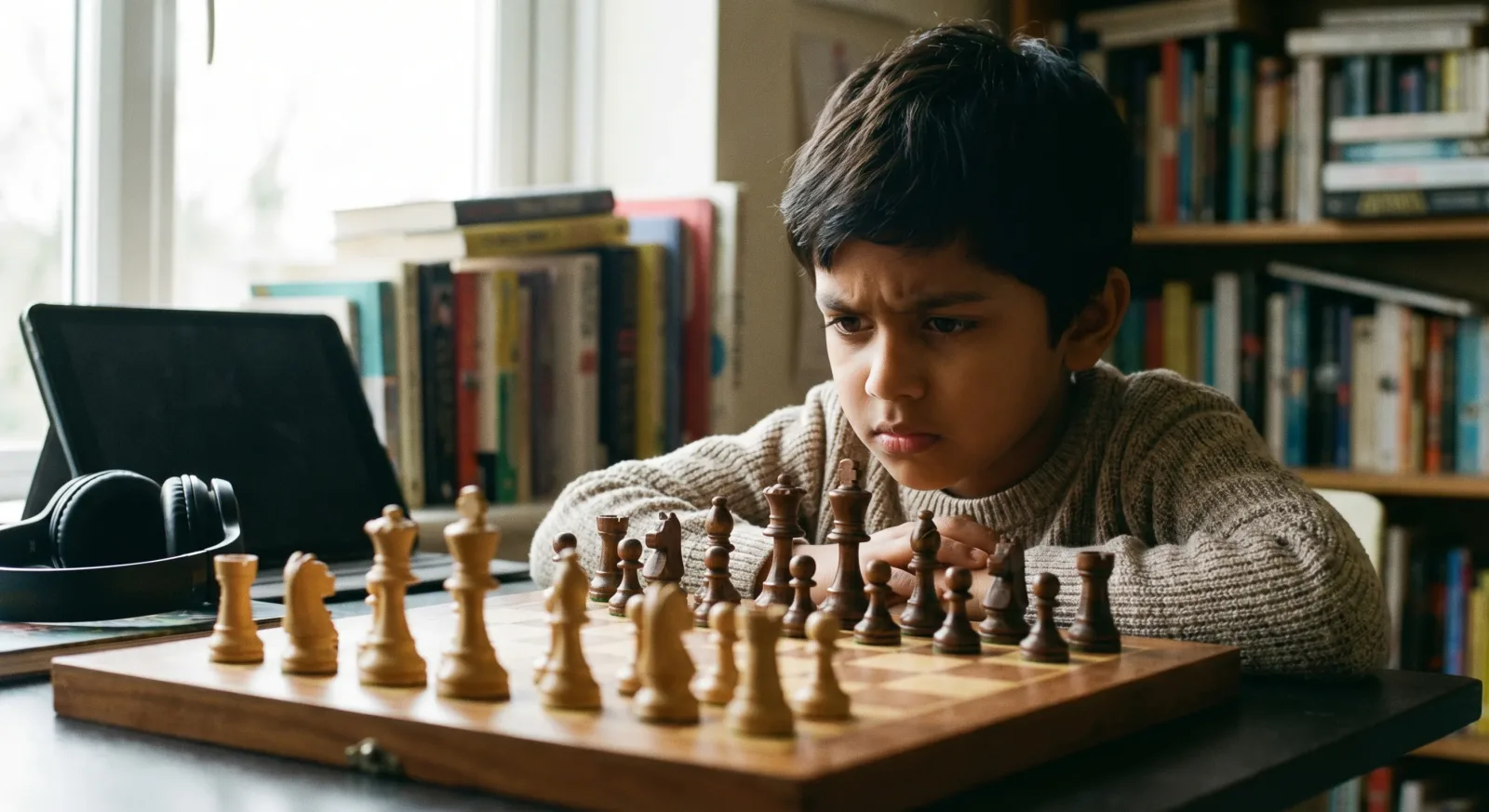
Chess Benefits for Kids: What the Research Actually Says#
By Coach Aryan Pal · Last updated 16 July 2026
Chess can support focus, pattern recognition, and emotional resilience in children — but only when it is taught and practised in a structured way. Casual app play alone shows weaker effects in research. Benefits are real, modest, and heavily dependent on consistency, coaching quality, and whether the child actually enjoys the game.
“Chess makes kids smarter” appears on every academy website in India. The claim is not entirely false — peer-reviewed work links chess instruction to small gains in mathematics and executive function. It is also routinely overstated, stripped of caveats, and sold as a shortcut around studying. This guide separates what the evidence supports from what marketing inflates, and I add what I see coaching beginners aged five to fifteen in live online sessions at ChessWize.
What does the research actually support?#
Honest answer first: chess instruction is associated with small to moderate positive effects on some cognitive skills — particularly mathematics and executive function — when children receive structured teaching over many sessions. It is not associated with reliable IQ increases when studies control for selection bias. It does not replace schoolwork, therapy, or professional care for attention disorders.
The strongest recurring findings in meta-analyses and systematic reviews cluster around three areas: sustained attention, spatial reasoning, and logical calculation. Weaker or contested findings include IQ transfer and automatic grade improvement without concurrent academic effort. FIDE’s Education Commission promotes chess in schools precisely because of the attention and planning demands a game requires — not because chess is a magic substitute for the classroom.
If you want the deepest treatment of one benefit, start with our dedicated guide on whether chess improves focus in kids. This page covers the full map.
Concentration and sustained attention#
A single classical game can demand sixty to ninety minutes of continuous focus from a child — no tab-switching, no passive scrolling. Few activities match that intensity for someone under twelve.
Research summaries published in journals such as Educational Research Review report small to moderate associations between chess instruction and improvements on sustained-attention tasks. The mechanism is straightforward: chess trains concentration through repeated practice under competitive pressure. Unlike passive screen use, every lapse during a game is punished immediately — a missed tactic, a blunder, a lost piece.
What I observe in my beginner cohorts at ChessWize matches the direction of that research, with an important caveat: children who only play bullet blitz without pausing to think show far less transfer than children who work through puzzles and coached review. The habit being trained is stop, calculate, decide — not click fast.
Parents often notice longer homework stamina before I mention it. I cannot prove chess caused that from anecdote alone, but the pattern recurs often enough that I treat structured chess as one useful tool among several for building attention stamina.
Pattern recognition and spatial reasoning#
Every chess tactic — the pin, the fork, the skewer, the discovered attack — is a visual-spatial pattern. A child who practises fifteen minutes of puzzles daily performs hundreds of spatial exercises per week. They learn to see relationships between pieces across a sixty-four-square grid and to visualise positions without touching the board.
Systematic reviews indexed on PubMed report associations between chess training and spatial reasoning in children roughly aged six to fourteen. Effects appear stronger when training is structured and competitive than when play is purely casual — which supports the coaching model we use in online chess classes for kids.
The honest phrasing is may support, not will raise marks. Chess correlates with geometry-friendly thinking; isolating chess as the sole cause of school improvement is difficult when children are simultaneously growing, attending CBSE or ICSE schools, and doing other activities.
Practice platforms like Lichess and Chess.com offer puzzle sets calibrated by difficulty, keeping children in the zone where problems are hard but solvable. Our chess tactics for kids guide names the patterns worth drilling at each stage.
Decision-making under time pressure#
Rapid chess gives a child fifteen minutes for all moves; blitz gives three. Every move requires evaluating the position, considering options, and committing under a clock that punishes hesitation.
Indian parents often ask whether this transfers to board exams. Chess-playing students frequently report that timed papers feel less paralysing because they are accustomed to deciding under pressure and moving on. That is self-report, not a controlled trial — useful colour, not proof.
FIDE lists planning under time pressure among the educational virtues of chess in its school programmes. The skill is real on the board whether or not it always appears on a report card.
Mathematical thinking#
The chess-and-math link is the most cited benefit — and the most overstated.
Chess shares structural features with mathematics: logical sequencing, pattern recognition, calculation, and evaluating multiple variables. A meta-analysis of twenty-four studies by Sala and Gobet (2016, published in Educational Research Review) found a small but statistically significant positive effect of chess instruction on mathematical performance in children. The effect was larger when chess was integrated into the school curriculum alongside regular maths teaching, and smaller when chess was a standalone extracurricular.
Practical translation: chess complements maths education; it does not replace it. A child who plays chess and studies maths will likely outperform an identical child who only studies maths — by a modest margin. A child who plays chess instead of studying maths will not absorb algebra from the board.
We explore the connection in depth in chess and math skills for kids.
Emotional regulation and resilience#
This is the benefit I care about most as a coach, and it is the least studied by researchers.
Competitive chess is emotionally demanding. A child who was winning and then blunders their queen experiences a sharp jolt — and must continue playing, fight back, and keep the next move rational. Over many games and tournaments, children often develop regulation skills that transfer to school setbacks: a bad test, a failed project, a selection trial they did not pass.
Parents tell me their chess-playing children handle academic disappointment with more composure than siblings who do not compete. I believe this because chess provides structured failure and recovery more often than most childhood activities — not because chess is mystical.
Our guide to a child’s first chess tournament in India explains how to frame losses as information rather than identity.
Chess and ADHD#
Interest in chess as complementary support for children with ADHD is growing. Small-scale studies and clinical observations suggest regular structured chess may support impulse control, sustained attention, and planning in some children with attention-related challenges.
The mechanism is intuitive: chess forces a stop-and-think sequence that ADHD disrupts. Every move requires pause, evaluation, consequence-checking, then action. Because feedback is immediate — you see the result of your move on the board — engagement can exceed worksheet drills for some children.
Important caveat: Chess is complementary, not treatment. It does not replace medication, therapy, or professional guidance. Read our dedicated chess for ADHD kids guide for an honest treatment of limits and practical setup.
Chess and school admissions in India#
This benefit is specifically relevant to Indian parents: a growing number of CBSE and ICSE schools treat competitive chess as a meaningful extracurricular for admissions conversations. Some metro schools with strong sports programmes actively notice students with tournament history.
An Elo rating or AICF tournament record gives admissions committees a verifiable metric alongside grades and other activities. A child who has competed in AICF-rated events and holds a published FIDE rating carries documented achievement that is harder to inflate than a generic hobby claim.
See chess for school admissions in India for how portfolios are actually evaluated.
How I tell whether chess is helping a specific child#
Parents ask me this after the first few lessons: “Is it working?” I refuse to answer with a rating prediction or a calendar promise. Instead I run a simple four-part check that I have used with beginners in our foundation track — children aged five to ten who have never moved a piece before joining a group class from ₹375 per session.
First: enjoyment without coercion. If a child needs constant bribing to open the board, no cognitive benefit will stick. I watch whether they voluntarily show a puzzle to a sibling or ask to replay a tactic from class. Voluntary return is the prerequisite for every other gain.
Second: pause length before the first move. In week one, most children snap out a legal move within three seconds. I do not criticise that — it is normal. I track whether the pause lengthens during coached sessions when I ask, “What is your opponent threatening?” A longer pause in session is a behavioural signal that inhibition and scanning are improving, independent of rating.
Third: error talk after losses. I ask every child after a practice game: “What happened?” Beginners say “I lost” or blame luck. Over time, coached children start naming concrete mistakes — “I left my knight forked” or “I did not see the pin.” That shift from global frustration to specific diagnosis is the resilience benefit researchers struggle to quantify but coaches see clearly.
Fourth: transfer stories from parents, treated as anecdote. I ask parents whether homework sessions lengthen, whether the child reads instructions more carefully, or whether meltdowns after school shorten. I log what they say; I do not publish it as data. When three unrelated families report the same transfer story in the same month, I treat it as a signal to keep the current routine — not as proof chess caused everything.
Here is a composite example, not one identifiable student. A seven-year-old in Hyderabad joins restless, tapping the desk through explanations. We keep sessions to forty-five minutes, puzzle-heavy, with one short game at the end. The parent practises ten Lichess puzzles on weekdays using our chess practice at home template. With consistent attendance — two live sessions per week — parents often report the child reads chess diagrams without rushing and sits through a twenty-minute puzzle set without leaving the chair. No rating jump is required for me to call that progress. The child is building the attention muscle the research describes.
When the check fails — child unhappy, no pause growth, parent reports nightly battles — I change the format before I blame the child. Shorter sessions, more two-on-one attention at ₹550 per session, or a break to try football and return later. Forcing chess on a resistant child defeats every benefit on this page.
Where the claims get overstated#
I want to be direct about what chess does not do:
- Chess does not raise IQ reliably. Sala and Gobet’s later work (2017 meta-analysis) found no significant IQ transfer when controlling for selection bias. Children drawn to chess may already have higher baseline cognitive traits.
- Chess is not a shortcut to academic excellence. It complements studying; it does not replace homework.
- Benefits require structured training. Random online blitz without analysis is entertainment, not the organised instruction research typically studies.
- Individual variation is enormous. Some children show rapid engagement; others enjoy chess recreationally without measurable school transfer. Both outcomes are normal.
The chess vs screen time question#
Parents ask whether chess time “counts” as screen time. It depends on the activity.
Watching passive chess videos is screen time similar to YouTube. Solving interactive puzzles on Lichess with a coach reviewing solutions is structured learning on a screen — cognitive demand closer to maths problems on paper. Playing rapid games while actively calculating is competitive mental exercise, not passive consumption.
Blanket screen limits rarely distinguish passive scrolling from active problem-solving. A child doing thirty minutes of tactical puzzles is not in the same cognitive state as a child scrolling social feeds for thirty minutes, even though both use a device.
We address the nuance in chess vs screen time.
From research to routine: what parents can actually do#
Research abstracts do not tell you what Tuesday evening looks like. This is the routine I recommend after a child completes a free 30-minute demo:
- Two live coached sessions per week in small batches (max six students) or two-on-one format so feedback is personal.
- Ten to fifteen minutes of daily puzzles on any free platform; Lichess costs nothing and integrates with coach assignments.
- One analysed game per week where the child names their biggest mistake aloud before looking at engine lines.
- One slow game per fortnight at rapid or classical speed to build stamina for over-the-board events.
That routine costs less than many extracurriculars when families start with the ₹2,500 starter pack (eight classes). Unused classes are refunded. The same FIDE-rated coach runs every session.
Families in Chennai, Pune, and overseas markets use the same structure online. ChessWize serves ages five to fifteen and holds a 5.0 on Google across 21 reviews — one data point, not a promise about your child.
If you are weighing chess against other activities or academies, our /compare page lays out format differences side by side.
Expert tips for maximising real benefits#
These are the practices I use with restless beginners and tournament-track students alike:
-
Pair every game with one spoken sentence about a mistake. “I hung my bishop because I did not check the diagonal.” That sentence is where reflection lives; the engine line can wait.
-
Keep puzzles shorter than games for young children. A five-year-old who fatigues after eight puzzles still trained pattern recognition that day. Forcing thirty puzzles breeds avoidance.
-
Use competition sparingly until losing feels survivable. Local school trials and friendly online tournaments build resilience; daily rating anxiety does not.
-
Let the child teach you one tactic per week. Explaining a pin to a parent forces retrieval — the same cognitive move that cements school learning.
-
Track attendance and effort, not rating. Rating fluctuates with opponent strength and format. Attendance and puzzle completion predict whether benefits have a chance to appear.
Frequently Asked Questions#
At what age do chess benefits become noticeable?#
Most research studies showing cognitive benefits involve children aged six to twelve who receive structured instruction for an extended period. Benefits may appear earlier, but they are harder to measure in children under six due to rapid natural development.
How much chess is too much?#
For most children aged six to twelve, one to two hours of daily chess-related activity (including lessons, puzzles, and play) is the practical ceiling. Beyond that, diminishing returns and potential burnout become concerns. Variety in a child’s activity portfolio matters.
Does competitive chess cause stress in children?#
It can — any competitive activity involves stress. The key is coaching that frames competition as a learning opportunity rather than a pass-fail test. Children taught to analyse losses constructively handle competitive stress much better than those pressured to win at all costs.
Is chess better than other extracurricular activities?#
Not inherently. Chess offers a unique combination of cognitive demands, but so do music, martial arts, robotics, and team sports. The strongest extracurricular is the one your child genuinely enjoys and will stick with long enough to develop real skills.
Can chess replace studying or professional care for attention difficulties?#
No. Chess is a complementary activity, not a medical intervention or homework substitute. For diagnosed attention difficulties, follow guidance from a qualified professional. Chess can support attention practice but does not replace treatment.
Do chess benefits require a coach or can apps alone work?#
Research showing positive cognitive transfer typically involves organised instruction with feedback. Casual app play alone is enjoyable but rarely produces the structured reflection associated with cognitive gains in studies.
Return to the main hub: Online chess coaching for kids in India.

Aryan Pal
ChessWize's content lead and coach for early learners. Specialises in making chess feel intuitive for first-time players. Designs the explainer videos, exercise sets, and parent-facing learning materials every student receives.
View FIDE ProfileReferences & Sources
- [01] Meta-analysis in Educational Research Review (2016) found a small positive effect of chess instruction on mathematics — sciencedirect.com/science/article/pii/S1747938X16300067, accessed 2026-07-16
- [02] Later meta-analysis by Sala and Gobet (2017) found no significant IQ transfer when controlling for selection bias — sciencedirect.com/science/article/pii/S0272771317302273, accessed 2026-07-16
- [03] FIDE recognises chess as an educational tool through its Education Commission programmes — education.fide.com, accessed 2026-07-16
- [04] NIH PubMed hosts systematic reviews on chess training and cognitive outcomes in children — pubmed.ncbi.nlm.nih.gov, accessed 2026-07-16
- [05] Executive function — attention, working memory, cognitive flexibility — is central to academic performance — en.wikipedia.org/wiki/Executive_functions, accessed 2026-07-16